Nevada HOA website requirements 2026 – What you need to know

{get_the_title()}
Kim Brown • • 9 min. read

Nevada HOA website requirements 2026 – What you need to know

Most states don’t legally require HOAs to maintain a website; however, Nevada does. What does that mean for your community? And can you just use Facebook instead?

We address those questions, and offer some best practices for building and maintaining an HOA website, in this article.

Table of contents

Most HOAs in Nevada are legally required to maintain a website

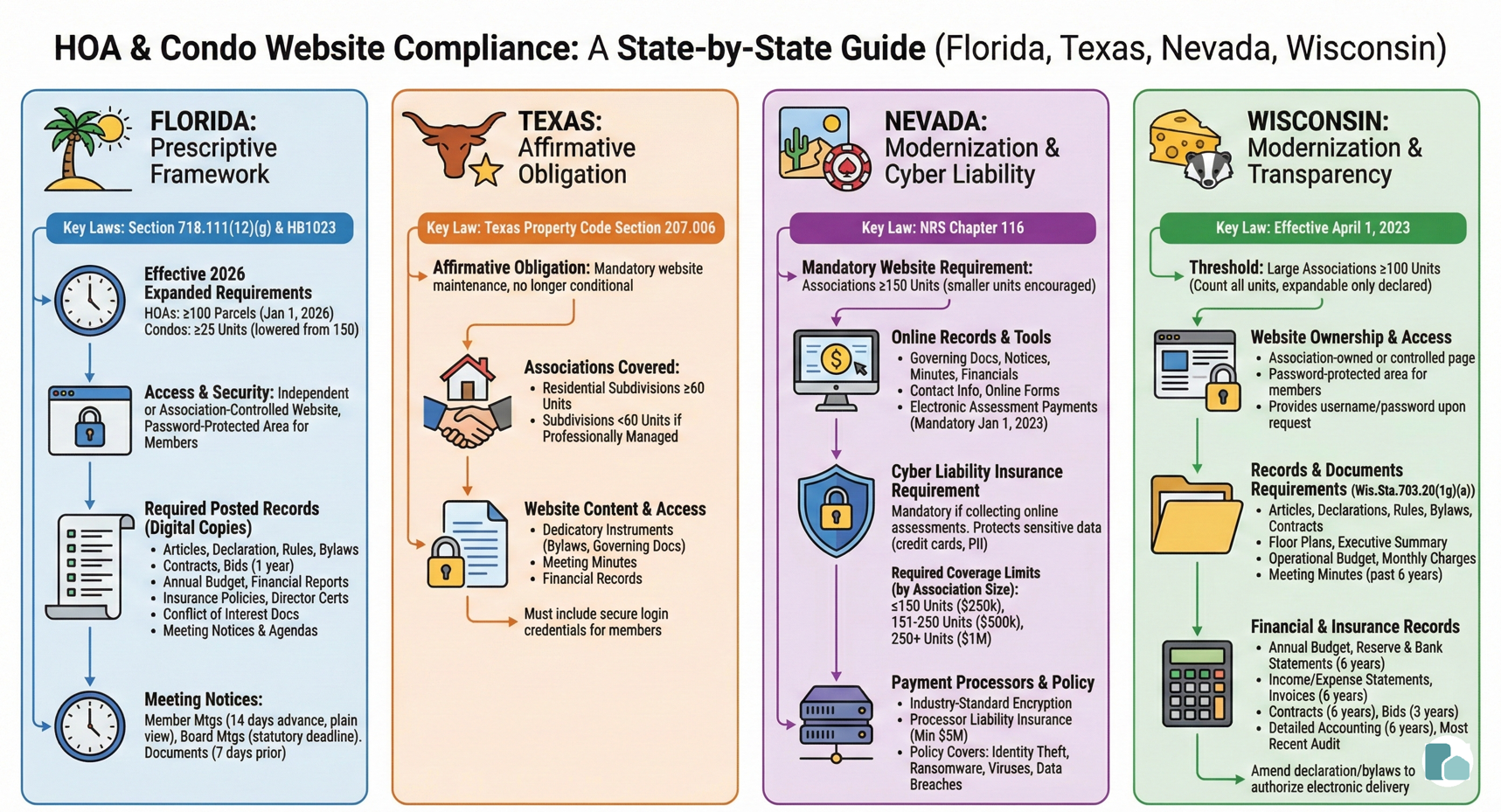
Common interest communities (otherwise known as HOA and condo associations) in Nevada with 150 units or more are required, by law (NV Rev Stat § 116.31069), to have a website or electronic portal that is accessible to all owners.

This law is not new. It was passed in 2021 and came into effect on January 1, 2023.

Below is a more detailed overview of the website law:

CHAPTER 116 – COMMON-INTEREST OWNERSHIP (UNIFORM ACT)

Establishment and maintenance of an internet website or electronic portal

Each association of a common-interest community that contains 150 or more units shall establish and maintain a secure internet website or electronic portal that may be accessed by any unit’s owner.

The association shall make available on the website or within the electronic portal the following documents:

      (a) The governing documents

      (b) The annual budget of the association and any proposed budgets

      (c) The notices and agendas for any upcoming meetings of the association

So, in addition to having a secure website or portal, the HOA must have the association’s governing documents, annual budget and proposed budgets, and notices and agendas for upcoming meetings.

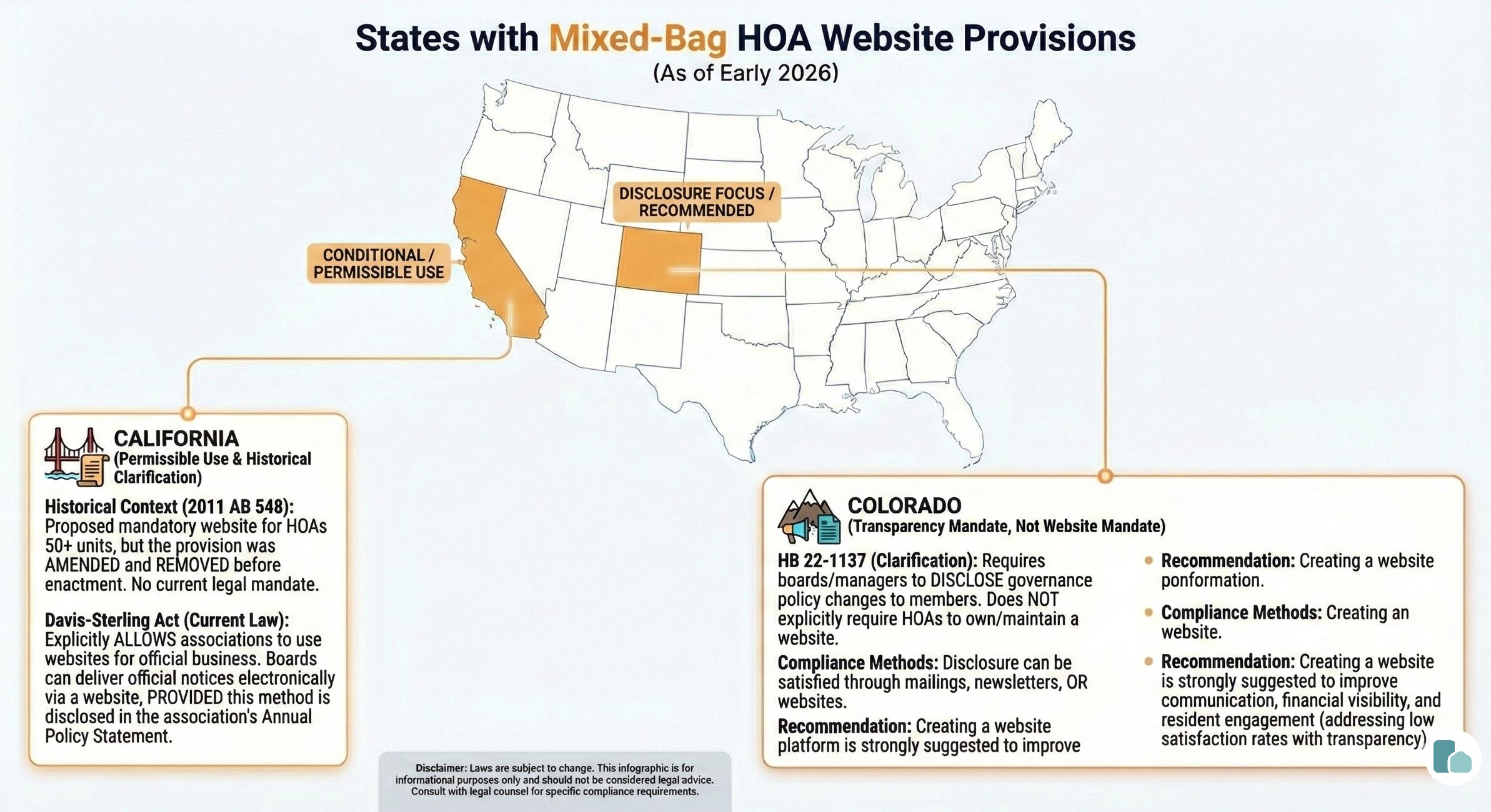
Only a few states have HOA website requirements at this time; however, more states could reasonably implement similar laws since the impact of having such a mandate is overwhelmingly positive for owners and HOAs as a whole.

Owners can make online payments through a website – provided certain requirements are met

The same set of laws also addresses online payments. The HOA website or portal may provide owners with the ability to pay fees or dues electronically only if:

(a) The association or payment processor maintains a policy of cybersecurity insurance in a minimum aggregate amount of $5,000,000 that provides coverage for potential losses associated with the unauthorized acquisition of personal information provided to process payments through the website or electronic portal, including, without limitation, losses caused by identity theft.

(b) For an association that has contracted with a payment processor that maintains a policy of cybersecurity insurance described in paragraph (a), the association must still hold its own policy of cybersecurity insurance in a minimum aggregate amount of:

  • $250,000 for associations with 150 or fewer units
  • $500,000 for associations with 151 – 249 units
  • $1,000,000 for associations with 250+ units

(c) The website or electronic portal allows the association or payment processor to suspend an owner’s ability to make a payment through the site or portal if past due obligations are assigned to a third party for collection.

(d) The association or payment processor complies with the requirements of NRS 603A.010 to 603A.290, inclusive, with respect to any personal information collected through the website or portal.

(e) The board has conducted an evaluation of the costs and benefits of providing owners the ability to pay fees online.  

In summary, the board must evaluate whether it’s in the association’s best interest before introducing online payments through a website or portal. That includes assessing the costs of cybersecurity insurance.

What if my community has fewer than 150 units?

Smaller condos and HOAs with fewer than 150 units are encouraged to have a website or portal, but are not legally required to maintain one.

You do not need a website if your Nevada HOA has less than 150 units.   

Why does my HOA need a website?

Lawmakers generally pass website legislation to help improve transparency, trust and engagement within community associations.

Owners have a right to view records

Sometimes, owners find it difficult to obtain important information such as budgets, policies or meeting details. Replies from management might be too slow, or their requests are altogether forgotten.

The important thing to highlight here is that, with a few exceptions, owners have a right to see HOA records.

Putting them online helps to ensure those records are readily available. Moreover, staff don’t have to spend time looking for physical records, and owners don’t need to pay photocopying or retrieval costs.  

Communities are more organized

A website or portal serves as a single, authoritative source for community information. Most people find it more convenient to get on a computer or smartphone to look up something than to physically go to an office and ask someone for that same information. With a user-friendly website, owners know exactly where to go to find what they need.

Websites can be tailored to provide more than the required information, too. Adding links to forms, amenity hours and rules, and contact information for preferred vendors, promotes smoother operations and reduces frustrations.

Furthermore, HOAs websites ensure everyone has access to the same, up-to-date information, effectively minimizing misunderstandings and confusion.  

Reduced workload for the board and management

Some admin work, such as collecting payments, manually processing maintenance requests, and responding to routine inquiries, can be drastically reduced with the help of website automation.

Less busy work means your board or manager has more time to focus on high-level work.   

Why can’t we just use Facebook?

Virtually every HOA has an unofficial Facebook group, and that’s not a bad thing. Owners can share announcements or information from the board with others, have discussions with their neighbors, and even sell items using a social media platform.

But, this is not the tool for community management, and any HOA attorney will advise boards to stay far away from Facebook and other social media groups.

There are a few reasons for this. For starters, it’s not easy for an HOA to control the narrative, especially if owners have the option to post anonymously. People often use this platform to complain, and conversations can escalate quickly. Board members should not be engaging in these conversations. Doing so can expose the community to liability issues, or, at the very least, create additional conflict between the board and other members.  

Social media platforms aren’t designed for organizing and storing important documents like bylaws, CC&Rs, budgets and meeting minutes in an easily accessible way. HOA websites, on the other hand, are designed for HOA-specific requirements.

Finally, social media platforms can change their policies at any time without requiring consent from users. These platforms don’t offer the level of security required for sensitive HOA documents and communications.

Tips for building and maintaining an HOA website

Perhaps your HOA didn’t need a website, but is interested in building one now. Or, maybe it’s time to get a site that better serves the community’s needs.

Regardless of your experience with HOA websites, these tips can help you find a solution that meets your needs and your budget.

Make a list of your HOA’s requirements and wishes

Your HOA website should be as unique as your association.

In addition to necessities, such as having a password-protected section for owners and a place to store documents, consider what features or functionalities you could include to improve communications or reduce the workload for staff and the board.

Many HOA-specific platforms go beyond the basics and can support online payments, maintenance request management, voting, classifieds, and more.

Your owners might not need so many extras, and that’s okay too. Just make sure the features that you do select are useful to owners and staff.    

Determine if a DIY or professional website design option is best

Website builders like Wix, Squarespace, and WordPress are popular and well-loved by businesses and individuals alike.

DIY platforms are almost always the more affordable choice. Bu,t the HOA needs to ensure that someone has the skills and the time to build the website.

The other option is to pay a company to build the website for your HOA. Since the website is customized, the price range can vary quite a bit depending on complexity, design, and the number of web pages.

HOA Sites balances professionalism with affordability.

HOA Sites provides HOA communities with a platform that makes it easy for them to build their own sites. However, the templates they offer are not mass produced. Instead, the company’s web designers build custom templates for every community.

With access to over 60 features, HOA Sites goes well beyond the standard HOA website. And the price is hard to beat.

People who feel a bit uneasy about putting together a website will be relieved to know that HOA Sites always provides a Personal Project Manager. This person offers suggestions and their expertise throughout the entire building process. That way, you can complete your HOA site with confidence and precision.    

Ensure your board or manager can make easy updates

Since documents and event dates require frequent updates, it’s best if someone from the board can make those changes on the site by themselves. If you need to call a developer every time a meeting notice needs to be posted, you might end up paying more than you planned to.

Keep mobile usage in mind

Owners will be using the website from their smartphones. It’s important to make sure that the platform is mobile-friendly and provides owners with a smooth experience.

Evaluate how much you can spend annually to maintain your website

In addition to paying a one-time fee to build a website, the HOA will need to pay recurring fees to keep it up and running. Costs may include domain name registration, web hosting, the SSL certificate, and plugins and premium addons.

Little costs can add up, so ask about recurring costs before you agree to anything.

Conclusion

If your HOA is in Nevada and has 150+ units, then it is legally required to have a website. While this isn’t a new law, it can be helpful for HOAs to understand why the law was passed and what it aims to achieve.

If your HOA is smaller, but you’re thinking about getting a website to manage communication and documents, give it a try! You might be surprised by how quickly your site generates traffic.

Can you really restrict big dogs in an HOA?

{get_the_title()}
Kim Brown • • 7 min. read

Can you really restrict big dogs in an HOA? Plus other common pet policies

Dogs are treated like (or better than) family in pet-friendly households.  But not everyone feels such affection for these four-legged friends.

Unfortunately, it’s usually bad owner behavior, and not bad dog behaviour that causes pet-related conflicts within HOA communities.

Pets are one of the main issues that HOAs encounter. It’s usually dog waste that creates problems, but complaints about barking, and aggressive behavior, are also received.  

That has led some associations to ask if they can ban dogs, or at least big dogs, from the community.

Though the matter is more complicated than many would think, it can be hard for a community to enforce this type of rule.

Table of contents

Can HOAs restrict all pets?

Yes, but it is not recommended. While this type of rule eliminates any grey areas, outright bans on pets are hard to enforce and can face challenges under the Fair Housing Act (FHA).

California HOAs cannot try to enforce such a rule. According to California Civil Code Section 4715, “No governing documents shall prohibit the owner of a separate interest within a common interest development from keeping at least one pet within the common interest development, subject to reasonable rules and regulations of the association.”

Under this law, a pet means any domesticated bird, cat, dog, aquatic animal kept within an aquarium, or other animal as agreed to between the association and the owner.

Can HOAs restrict big dogs?

Yes. Unless there are laws that state otherwise, HOAs can place restrictions within pet policies.  Restrictions may target the size, total number, or breed of pets. 

These limitations must be stated in the community’s governing documents, and are intended to maintain harmony and safety for all residents. 

If a size limit exists, it is usually in the form of a weight limit. For example, owners and residents cannot have dogs that weigh more than 50 pounds.

Why restrict large dogs? Some think it’s because they expel more waste, creating more mess. Others who are concerned about safety may argue that bigger dogs are harder to control, and have the potential to inflict greater harm.

Though these arguments are valid, there is a growing belief that it makes more sense to regulate behavior as opposed to size or breed. After all, good dogs come in all shapes and forms.

Can HOAs restrict certain breeds?

Yes, and breed-specific legislation (BSL) exists in multiple states. For example, in Arkansas, Indiana, Iowa, and Kentucky, pit bulls are still subject to legal restrictions.

Other common HOA pet policies

Pet polices differ depending on the needs of the association. The goal is to make the community a happy and safe place for everyone. That can be a tough thing to do, but HOAs use some of these additional policies to try and strike that balance:  

  • Limit on the number of pets allowed per household. Often, that number is 2 or 3
  • Reasonable restrictions when it comes to the type of pet that can be housed. You might be surprised by the types of animals people have tried to keep as pets
  •  Leash, control, and common-area rules. This is very important to promote and enforce
  • Waste cleanup and sanitation. Include information about what happens for noncompliance so that owners are aware of the consequences
  • Noise, nuisance, and aggressive behavior. Define what counts as a “nuisance” or “aggressive behavior,” as well as what happens if a pet has been aggressive around other members (warnings, fines, removal)
  • Clearly identify any pet-free zones or restricted areas, including pools, playgrounds or the clubhouse
  • Clearly identify any amenities or infrastructure designed for pets (dog parks, waste stations)
  • Clearly list registration, identification, and vet record requirements. Some HOAs require registration, proof of vaccination and tags
  • Details about liability, insurance, and indemnification. State whether pet owners are responsible for costs associated with damage, injury, or biting

Ensure that policies are up to date and easy to access. Storing them on the HOA’s website allows owners to review them at any time, from anywhere.

A quick note about grandfathering

While consistency is important when it comes to enforcing any community rules, sometimes, things change.

Rules and policies need to be updated from time to time as circumstances and expectations change. However, if implementing those changes could have a negative and serious impact on existing members, the HOA board may choose to include a grandfather clause.

This means the new or revised rules do not apply to existing members unless their situation changes.

In the context of pets, an HOA may decide to place a limit on the number of pets one household can have at any given time. Let’s say that number is 2. However, a small group of owners already have 3 pets.

Instead of asking those people to find a new home for one of the pets, the HOA will use a grandfather clause that exempts them from the new rule. They can keep all of their existing pets without issue.

However, these owners are not permitted to have more pets, and if one of the pets passes away, they cannot get a new one. Once their situation changes, in this case, a pet passes away, they must follow the new rules.   

Eventually, the board will be able to phase out the grandfather clause once the change or amendment is enforceable to all members.

What about service dogs?

The Fair Housing Act protects people from discrimination when renting, buying, or financing a house, and when pursuing other housing-related activities. Under this federal law, people with disabilities can request reasonable accommodations from their associations. This includes the right to have a service animal.

HOAs cannot enforce breed or size restrictions on a service animal. However, the HOA still has the right to require that the owners of these animals follow the rules. That includes abiding by leash regulations, and following through with waste clean-up.

What about emotional support animals?

Emotional support animals are more complicated and will be addressed in another article. However, since a support animal is not a pet, an owner may be entitled to have the animal, even if the HOA has an established no-pet policy.

Associations cannot refuse to make reasonable accommodations when such accommodations may be necessary to afford an owner with a disability an opportunity to use and enjoy their home.

If an owner is requesting to keep a unique type of animal, for example, a pig, the burden is on the requester to demonstrate a disability-related therapeutic need for the animal. Associations should not rush to deny the request, but instead seek to gain credible information regarding the request.

Solutions to curb poor owner behavior 

Pet issues are not always easy to solve. Many communities struggle with pet waste issues simply because incidents occur quickly, and it can be very hard to prove that someone didn’t clean up when they should have.  

If general reminders and warning letters aren’t working, it might be time to try a more something more effective.

Install waste disposal stations

Having a place to dispose of waste will encourage owners to pick up after their pets during walks. If possible, provide bags at the stations so that owners really have no excuse for not cleaning up.

Enforce the rules whenever possible

If management or a neighbor knows who isn’t picking up after their pet, the association should notify the owner. Follow the association’s enforcement process to ensure fairness and consistency. Fines are generally a good way to get owners to change their behavior.

DNA testing

If pet waste is becoming the community’s main pain point, there are companies out there that will test feces and provide DNA results to the association. This is an expensive, but effective way to get owners to clean up after their pets.

The big catch is that dog owners must first provide the HOA with a DNA sample from their pets. Typically, all that is needed is a cheek swab, but some owners might be reluctant to participate in this program.

HOAs will also need to determine if testing costs will be charged back to the owners, or if this is something that comes out of the association’s budget.

Navigating HOA décor: Can you have lights up all year?

{get_the_title()}
Kim Brown • • 6 min. read

Navigating HOA décor: Can you have lights up all year?

HOAs favor uniformity to maintain or enhance property value. For this reason, they create architectural standards and complementary rules so that homes are aesthetically pleasing to all.

While some owners may view the standards as limiting or bland, they prevent owners from disrupting neighbors with flashy light displays or loud animatronics. You won’t see outdoor Christmas trees on an HOA lawn in the middle of July.   

Most HOA members know that there are limits when it comes to traditional holiday decorations. But what about subtle white lighting or modest décor?

In this article, we’ll cover the general rules, plus get into more detailed elements of décor restrictions.

Table of contents

Why do HOAs need rules for holiday décor?

As discussed earlier, aesthetics are important to HOAs. They value uniformity, which is why they create limits on what owners can do when it comes to decorating their homes.

However, when it comes to the Fourth of July, Halloween, Thanksgiving and Christmas, this matter is rarely simple.

That’s because there is no “standard” for decorations. As a result, some communities will have very strict rules, while others will allow inflatable decorations on lawns or decorative reindeer on the roof.

You will need to refer to your HOA’s décor policy to find out how creative you can get when it comes to making your home look festive.

Common holiday décor rules

While the rules for décor vary quite a bit, many communities have similar time periods for holiday décor.

Owners may have permission to start decorating as early as 30 days before the holiday begins, and anywhere from 2 weeks to 1 month to remove décor after the holiday ends.

Size and placement are also addressed so that owners can enjoy holiday fun without going overboard. For example, if inflatable Santas are allowed, owners may be limited to 1 per household.

Most HOA decoration rules include restrictions regarding:

  • Noise – rules may limit the use of decorations that produce sound. This can include musical lights.
     
  • Size – some HOAs prohibit oversized inflatables, large displays, or items that could obstruct views or pose safety hazards.
     
  • Timing – there are timeframes for which holiday decorations can be put up and removed.
     
  • Color – certain color schemes may be required to maintain a uniform appearance.
     
  • Etiquette – HOAs typically prohibit offensive or inappropriate themes. Some Halloween décor might be too gory.
     
  • Location – restrictions can also apply to the placement of décor, limiting displays to doors and windows and not allowing anything on rooftops or trees.

Are there limits for religious symbols/décor?

This question can be harder to navigate, so always contact the HOA attorney if you have doubts.

The Fair Housing Act prevents HOAs from establishing guidelines that are discriminatory against any owner who observes or practices a particular religion.

For example, bylaws should never say that community members can’t display “Christmas decorations”, “Hanukkah decorations” or other decorations specific to a particular religious holiday.

Instead, bylaws might ban certain types of “holiday decorations or displays,” in general.

Boards may adopt reasonable rules limiting when owners can start decorating and how long decorations can remain up after the holiday has passed.

In California, according to Davis-Stirling, community associations cannot prohibit the display of religious items on entry doors and door frames (Civ. Code § 4706). These can be displayed permanently.

In this instance, a religious item is defined to mean an item displayed because of sincerely held religious beliefs. Religious symbols that qualify include the Jewish Mezuzah and the Christian cross. Davis-Stirling adds that Christmas wreaths and lights would not likely qualify as religious symbols.

Associations can impose some limitations to prevent these symbols from:  

  • threatening public health or safety
  • hindering the opening or closing of any entry door
  • violating any federal, state, or local laws

Displays cannot be more than 36 by 12 square inches, individually or combined.

Religious symbols and displays may be permitted year-round, but there will be limitations as to where they can be placed and how large they can be. Always check rules and bylaws first to see what limitations apply to your HOA.

What about subtle lighting?

Permanent, programmable, exterior LED lighting systems, Trimlight being one of the most popular options, are designed for year-round use. 

These systems are installed along the roofline of the home and allow for customizable, color-changing displays for holidays, special events, or general aesthetic enhancements. 

This type of system might be allowed, but you should check for any light-specific policies first, as rules can differ significantly depending on your community. Furthermore, your HOA probably won’t permit you to display green and red lights in the middle of summer, but this would be okay around Christmas time.

Many U.S. HOAs do not address outdoor lighting requirements. However, those that do tend to focus on preventing light trespass, which is a condition where light originating from one property is received on another. If your HOA is silent on this issue, consider making guidelines for your owners.

Some HOA lighting rules may include timing schedules for lights to be on. For example, the exterior lights must be turned off at 11 p.m. While that rule doesn’t prevent light from trespassing onto another property, it at least prevents owners from being exposed to too much light late a night.

Décor policies should be clear and reasonable

The best way to ensure HOA owners follow décor and lighting rules is to:

  1. Establish clear, specific rules that address timeframes, location and size. Ambiguous policies lead to confusion and misunderstandings. Plus, it would be very unfortunate for someone to spend a lot of money on something only to later find out that they can’t have it in their front yard.
  2. Make sure those rules can be accessed with ease. This is where having a website comes in handy. By sharing rules or policies on a password-protected section of your HOA site, you ensure everyone has the most current information at their fingertips without first having to request it from you or your staff.

When everyone knows what’s expected, misunderstandings and violations are minimized, and the holidays can be celebrated as they were intended.

Associations are encouraged to find a balance between maintaining an aesthetically pleasing environment and allowing owners to enjoy the holidays. Remember that rules can be amended if they are no longer relevant or useful.

Rules that are not in writing cannot be enforced.

Finally, be prepared to enforce the rules. If there are no consequences for ignoring rules, owners have no real reason to follow them.

Texas’ HOA website requirements 2025 – What you need to know

{get_the_title()}
Kim Brown • • 6 min. read

Texas’ HOA website requirements 2025 – What you need to know

Big belts, big hats, and big attitudes. Things tend to be bigger in Texas. But when it comes to HOA websites, size doesn’t matter.

Whether your community has 100 members, or 4,000 members, Texas HOAs need to have a functional website.

Table of contents

Is the Texas website law new?

No. Senate Bill 1588, which introduced several key requirements for HOA websites, went into effect on September 1, 2021.

Sec. 207.006. of the Texas Property Codestates that HOAs must have a website if:

(1)  the property owners’ association of a subdivision is composed of at least 60 lots; or

(2)  a property owners’ association has contracted with a management company.

Furthermore, the association has to post the current version of “dedicatory instruments relating to the association or subdivision,” and those filed in the county deed records, on the website.

It probably goes without saying, but the documents must be available to association members.  

We’re resharing this information because it never hurts to have a refresher on HOA laws. Plus, new members may not be aware of these requirements.  

What specific documents need to be on the website?

Does everything have to go on the website? Not exactly, but most records are required to be available through the website unless they are considered confidential. Approved documents include:

  • Essential information
    • The association’s name
    • Management certificate
    • Governing documents (declarations, bylaws, rules, regulations)
    • Contact information for board members and the management company

Then there are the dynamic records like:

  • Annual budgets
  • Reserve fund information
  • Notice of board meetings
  • Agendas
  • Minutes
  • Architectural review processes and guidelines

Why was this law passed?

The Texas Property Code serves as the cornerstone of property laws in the Lone Star State, governing both residential and commercial real estate transactions, landlord-tenant relationships, and property rights.

When it comes to HOAs (or POAs), the Texas Property Code regulates the establishment, governance, and operation of associations of homeowners, including rules for membership, assessments, covenants, and enforcement actions.

It aims to protect the rights of owners, promote fair and transparent transactions, and promote orderly and harmonious neighborhood development.

So, what does all that have to do with a website? Well, websites are generally seen as convenient and accessible communication platforms. You only need a computer or smartphone, and internet connection to access a site, and virtually everyone has been on a website before.   

By posting HOA documents online, associations are giving owners 24/7 access to essential community information such as budget details or meeting minutes.

Owners have a legal right to see most association records. However, in the past, they would have to speak to a person and sometimes wait weeks to see the information they asked for.  It is a slow and inefficient process that is not only frustrating for owners, but also takes valuable time from admins or board members.   

Posting documents online creates more transparency and accountability. Yes, it takes some effort to update records, but it’s much easier (and more affordable) to do that than print out 20 copies of the same budget.

When owners can see how the HOA is performing, good or bad, they are more likely to show up to meetings, ask productive questions, and get involved.

Is it safe to have all of this information online?

Yes, provided you consider security when creating your website. HOAs are strongly encouraged to have a password-protected section on the site where owners can log in and access association records.  

HOA Sites can ensure security and compliance and build a solution that meets all of your needs.

Not only will your community get a professional and functional website, but you can enjoy other useful features like online payments, reports, calendars, event registration and bulk messaging.  

By incorporating these elements, your website not only meets legal requirements but also enhances the overall community experience.

You can certainly hire a different website designer, or pay for a DIY website, but not all options will cater to the specific needs of HOAs.

What else should we know about record keeping?

The Texas Property Code has additional rules when it comes to storing and accessing HOA record keeping.

For example, Texas law requires a property owners’ association composed of more than 14 lots to implement a records retention policy.

A records retention policy identifies important records and states how long they must be kept. Section 209.005(m) of the Texas Property Code establishes mandatory retention times for some records, including:

  • Certificates of formation, bylaws, restrictive covenants, and all amendments (permanent retention)
  • Financial records, tax returns, and audits (7 years)
  • Meeting minutes (7 years)
  • Account records of current owners (5 years)
  • Contracts of one year or more (4 years from the end of contract term)

Additionally, most residential subdivisions are required to provide owners with access to the books and records of the association if they submit a written request. An owner can either request to inspect the records in person or request copies of specific documents.

The association can charge a fee for copies if they have created a records production and copying policy that specifies the charges in advance.

Records must be requested in writing by certified mail. The association must respond within 10 business days. That deadline can be extended up to 15 additional days if the association provides a proper written notice.

That’s a lot of tedious admin work for both parties. A website can save staff and owners time and money by hosting the records. Owners can review them whenever they’d like, and they don’t need to ask permission to see them.

Confidential records

As mentioned earlier, not every record can be shared with owners. Confidential records must be protected and viewed only by those authorized to do so. The association may rightfully deny access to these documents, except by court order or an affected individual’s consent. 

Confidential records include:

  • Attorney files and records
  • Rule violations committed by a specific owner
  • Financial information, including nonpayment of dues, belonging to a member
  • An owner’s contact information, except for their mailing address
  • Information about the association’s employee, including their personnel file

Conclusion

Texas is not the only state to pass HOA website laws. Florida, Nevada and Wisconsin all follow similar legislation. The intent is to establish transparency for owners, and ensure associations remain accountable.

HOA websites are beneficial to board members and association staff as well. Owners can be directed to the website when they ask to see certain documents. As a result, workloads are lightened, allowing staff to focus on more complex tasks.  

If you have more questions about website compliance, or would like to upgrade your current site to something more modern and practical, don’t hesitate to contact us.