Wisconsin HOA transparency laws 

{get_the_title()}

Wisconsin HOA transparency laws

Wisconsin is home to roughly 5,700 community associations housing around 777,000 residents across 325,000 homes. That is approximately 13.2% of the state’s population living under community association governance. Whether you are in a townhome, condo, multi-unit building, or even a timeshare community, you are likely part of these associations. 

I have worked with community associations across the country, and I can tell you that Wisconsin takes a unique approach to HOA governance. The state doesn’t have one comprehensive statute governing all community associations. Instead, the legal framework is fragmented. But one thing is common: Wisconsin has transparency laws that aim to safeguard the interests of residents. 

Understanding which transparency laws apply to your association will help you meet compliance requirements for that specific association structure. Let me walk you through what you need to know about HOA transparency laws in Wisconsin.

In my years working with Wisconsin boards, I have found that many directors don’t realize their association operates under different laws depending on whether they are a condominium or an HOA. This matters because your compliance obligations vary significantly. 

Condominium associations 

If you are managing a condo association, you’ll operate under the Wisconsin Condominium Ownership Act, Chapter 703 of Wisconsin Statutes. This law spells out your rights and responsibilities as unit owners and associations, covering declarations, bylaws, common expenses, assessment liens, insurance requirements, and dispute resolution. You’ll need to file a declaration with the county register of deeds where your property sits. 

Homeowners associations 

Here is where things get interesting: HOAs in Wisconsin don’t have a dedicated governmental act overseeing them specifically. Most HOAs, particularly those in planned communities that aren’t condominiums, are structured as nonstock corporations, which means you’ll follow the Wisconsin Nonstock Corporations Act, chapter 181 of Wisconsin Statutes. 

Without standardized regulations for HOA management, the rules can look dramatically different from one community to the next. I have seen associations with vastly different governance structures, all operating legally. Associations essentially have free rein to establish whatever regulations they want, as strict or as lenient as they choose, provided they don’t violate state or federal law.

What nonstock corporation act requires

Chapter 181 serves as the foundational corporate framework for the vast majority of homeowner associations throughout Wisconsin. In my experience, boards often overlook these requirements until they face a challenge from a homeowner. Let me break down what the law requires in terms of transparency: 

Member inspection rights  

Members have the right to examine and obtain copies of certain HOA records, provided they give the HOA at least five business days’ written notice before they want to inspect. The inspection must happen at a reasonable time and location that the corporation specifies. Records available for inspection include accounting records, the membership roster, although this is subject to limitations, and portions of other required records. 

Financial statement requirements 

When a member submits a written request, you must provide your most recent annual financial statements. These need to show a balance sheet from the end of the fiscal year and an operations statement covering that year. I have worked with boards that scramble to pull these together, so I recommend keeping them readily accessible. 

Meeting notice requirements 

Special board meetings require at least two days’ advance notice to each director. The notice must specify the meeting’s date, time, and location, though it doesn’t need to explain the meeting’s purpose. 

When notifying members about an annual, regular, or special meeting, you must also include notice of any matter a member plans to raise, but only if someone authorized to call a special meeting requests this in writing, and the secretary or president receives the request at least 10 days before you send out meeting notices. 

Website publication requirements 

Starting January 1, 2023, if your residential planned community association maintains a public-facing website with community information, you are required to publish the community’s covenant and restrictions on that site.

Wisconsin Act 199

In 2021, Wisconsin enacted Act 199, and I have watched it transform how HOAs operate. This legislation gives residents, whether they are current homeowners or prospective buyers, access to the rules and regulations that affect their properties. That means transparency isn’t just about good governance anymore, but it is a legal requirement. 

Filing requirements with the state 

HOAs now have a mandatory filing obligation with the Wisconsin Department of Financial Institutions. Here is the timeline you need to follow: 

  • For associations that existed on December 14, 2022, the deadline for initial public notices was January 13, 2023. 
  • For any HOA established on or after December 14, 2022, you must file the initial notice within 30 days of the association’s creation. 
  • Condominium associations are exempt from these filing requirements. 

After the initial filing, you must submit annual renewal notices by December 31 each year. Also, whenever information in a filed notice changes, you have 30 days from the date of the change to file an amended notice. 

Consequences of non-compliance 

I have seen boards get caught off guard by this: if you don’t file a required notice, you lose the ability to charge late fees or impose other penalties for unpaid assessments from residential lot owners. You also cannot charge any fees related to ownership transfers until you bring your filings up to date. That is a significant financial impact for most communities. 

Required information 

Both initial and renewal notices must include: 

  • Association name or registered HOA name 
  • Association mailing address 
  • Association website, if one exists 
  • Contact person’s name, address, email address, and phone number. This information appears on DFI’s public website. 
  • Management company information, if applicable 
  • County and municipality where the planned community is located 
  • Payment information. Note that the filing fee is $25, payable via credit card 

Recording covenants and restrictions 

You must now officially record your covenant and restrictions with the registrar of deeds in the county where your community is situated. If you operate a website, these documents need to be available there as well. 

Notice requirements and financial disclosures 

The act establishes specific time frames for HOA communications: 

  • Meeting notices must be provided at least 48 hours in advance 
  • Homeowners requesting payoff statements must receive them within 10 business days of their request.

Special requirements for large condominium associations 

Through 2021, Wisconsin Act 166, the state legislature added requirements that apply specifically to condominium associations with 100 or more units. This new law came into effect on April 1, 2023. If this describes your association, you must establish and maintain a website meeting specific conditions, and failure to comply opens the door to enforcement actions from association members and unit owners. 

Website requirements 

The website must satisfy these criteria:

  • The condominium association must either fully own and operate, or a third-party must operate it under an arrangement where the association owns, leases, rents, or otherwise secures the right to operate a site dedicated to their activities 
  • Access must be restricted to condominium unit owners and association employees only, and not available to the general public 
  • It must securely store current copies of records that the condominium association is required to maintain 
  • Access requires a username and password, which unit owners or condominium association employees can obtain by submitting a written request to the association 

Required content 

Your website must provide:

  • Documentation, like meeting minutes and records of actions taken without meetings by unit owners over the previous 6 years 
  • Copies of foundational documents, such as the declaration, bylaws, rules, regulations, articles of incorporation, management contracts, employment contracts, or other agreements affecting how all or part of the condominium is used, maintained, or accessed 
  • The current operating budget and monthly fees for using, renting, or leasing any facilities not part of the condominium itself 
  • Information about any planned condominium expansion 
  • A floor plan copy showing common elements and other facilities available to unit owners 
  • An executive summary meeting the information and formatting standards required by Wisconsin Stats. section  703.33 (1) and (2) 
  • Comprehensive records from the past 6 years detailing receipts and expenditures related to common elements, including itemized maintenance and repair costs 
  • Income and expense statement covering the past 6 years 
  • Insurance policies issued during the past 6 years 
  • Annual budgets, financial statements, bank statements, and account statements, including reserve account statements created within the past 6 years 
  • The most current audit of the condominium association’s financial records, if one exists 
  • Contracts signed within the past 6 years and any bids for those contracts received within the past 3 years 
  • Invoices and expense records generated within the past 6 years

The practical reality

Even if a website isn’t yet a legal mandate for HOAs in Wisconsin, I can tell you that the stringent transparency requirements essentially make having one a practical necessity. For instance, the legal obligation to notify residents about meetings and to make governing documents and financial statements accessible can only be efficiently managed through an association website. And because the current law already recognizes association websites as legitimate platforms for communication and document accessibility, maintaining one saves you considerable administrative effort. 

Also, considering that the law already mandates large condominium associations to maintain websites, looking to the future, I expect subsequent amendments will make websites legally mandatory for HOAs as well. The trajectory is clear: Wisconsin is moving toward greater transparency, and boards that get ahead of these requirements will find governance much easier. The good news is that platforms like HOA Sites specialize in helping community associations set up and maintain websites that meet legal requirements. Once your website is set, homeowners will be able to access CC&Rs, bylaws, meeting notices, and financial statements directly from your website, and that transparency builds the trust your community needs to thrive. 

Nevada HOA transparency laws 

{get_the_title()}

Nevada HOA transparency laws

Homeowner associations always spark strong reactions. People either love them or can’t stand them. Yet regardless of where you fall on that spectrum, HOAs represent the nation’s fastest-expanding type of residential governance. In Nevada alone, over 500,000 homeowners live within HOA communities, with 3,460 associations operating statewide. 

I have seen how these associations function as private nonprofit corporations under Nevada law, while simultaneously serving the broader public. This creates an interesting dynamic when we talk about transparency requirements, and it’s a conversation I have with board members regularly.

The common pushback I hear is: “HOAs are private entities. Why should we face the same scrutiny as government agencies or publicly traded companies?” While this argument might initially seem reasonable, it doesn’t hold up when you examine how legislation regulates other “private” organizations that interact with or impact the public. Let me walk you through what Nevada law actually requires from your board.

The Nevada Revised Statutes establish the legal groundwork for homeowners’ associations throughout the state. Specifically, Chapter 116 of the Nevada Revised Statutes, commonly referred to as the Common Interest Ownership Uniform Act, or simply UCIOA, forms the cornerstone of Nevada’s HOA legal framework. 

This chapter outlines extensive provisions covering everything from how common interest communities are created and managed to how they are eventually resolved. Chapter 116 tackles critical areas including board elections, meeting procedures, fee collection processes, and methods for resolving disputes. The legislation aims to safeguard homeowner rights while simultaneously ensuring HOA boards govern fairly. 

What makes Nevada’s approach distinctive? Unlike states such as Wisconsin that maintain separate legislative acts for HOAs and condominium associations, Nevada’s UCIOA takes a comprehensive approach, covering all types of community associations, whether they are traditional HOAs, condo associations, or planned communities. 

If you are serving on an HOA board or managing an association, understanding NRS 116 provisions is essential. Let me break down what Nevada law requires from you regarding transparency obligations.

How the UCIOA promotes transparency

Homeowners’ associations function using democratic principles at their core. That means certain decisions require input from all homeowners through voting, while other matters fall under the jurisdiction of the executive board or various committees created by the association or outlined in governing documents. 

The state guarantees residents specific rights related to ownership in common interest communities. Based on the provisions outlined in Chapter 116, here is what property owners are entitled to: 

Notifications for unit owner meetings 

Your association secretary or designated officer must notify unit owners of upcoming meetings within a specific time frame, not fewer than 15 days and no more than 60 days before the scheduled meeting. These notifications must follow the delivery methods specified in NRS 116.31068. 

Meeting notices need to clearly state when and where the meeting will occur and must include the meeting agenda. Additionally, notices must inform unit owners about their entitlement to receive meeting minutes or minute summaries upon request. These documents should be provided electronically at no cost, or if electronic delivery isn’t feasible, in paper format, with the charges capped at 25 cents/page for the initial 10 pages, then 10 cents for each subsequent page. 

Documentation of unit owner meetings 

At every meeting involving unit owners, the secretary or other designated officer must ensure minutes are recorded or documented. Within 30 days following each meeting, these officials must make the minutes or a summary available to unit owners. 

Unless specified otherwise, any unit owner who requests a copy should receive the minutes or a summary in electronic format free of charge. If your association cannot deliver electronically, paper copies must be provided at rates not exceeding 25 cents/page for the first 10 pages, followed by 10 cents per page for additional pages. 

What goes into meeting agendas 

Meeting agendas for unit owner gatherings must contain a transparent and thorough description of topics scheduled for discussion. This includes any proposed modifications to the declaration or bylaws, new fees or assessment increases the association plans to implement, budgetary adjustments, and any proposals to remove association officers or executive board members. 

Executive board meeting notifications 

Barring emergencies or unless your association’s bylaws mandate longer notice periods, secretaries or other designated officers must notify unit owners at least 10 days before executive board meetings. This notification can be delivered either through the methods outlined in NRS 116.31068 or by publishing the information in a newsletter or a similar publication distributed to every unit owner. 

Executive board meeting notice requirements and owner participation 

Notices for executive board meetings must specify the meeting’s time and location and include either a copy of the agenda or details about where and when unit owners can conveniently obtain agenda copies. 

These notices must also inform unit owners of their rights to obtain audio recordings, written minutes, or minute summaries upon request. Just like with unit owner meetings, these materials should be provided electronically at no charge, or in paper format at a maximum cost of 25 cents/page for the first 10 pages, then 10 cents per page thereafter. 

Access to association documentation 

When unit owners submit written requests, the executive board must make the association’s books, records, and other documents available for examination. These access includes, but aren’t limited to: 

  • Financial statements of the association 
  • Budgets that the association prepares according to NRS 116.31151 requirements 
  • Reserve studies that the association conducts as mandated by NRS 116.31152 
  • All contracts where the association is a party, plus any court-filed records related to civil or criminal proceedings involving the association 

Annual budget distribution requirements 

Between 30 and 60 days before your association’s fiscal year begins, the executive board must prepare and deliver to each unit owner copies of: 

  • An operational budget that covers the association’s daily activities. This budget must detail estimated annual revenues and expenses, along with any planned contributions to the association’s reserve account. 
  • A reserve funding budget that ensures adequate financial reserves as required by law.

Nevada’s website requirements for common-interest communities

Starting January 1, 2022, associations in common-interest communities with 150 units or more must establish and maintain a secure website or electronic portal accessible to any unit owner. These associations must post the following materials on their website or portal: 

  • All governing documents 
  • The association’s annual budget, along with any proposed budgets 
  • Notices and agendas for all upcoming association meetings 

For associations with fewer than 150 units, establishing and maintaining a secure website or electronic portal is optional, though the law encourages it. 

Beginning January 1, 2023, the mandated website or portal must also provide unit owners with the capability to pay their assessments electronically.

Nevada’s recent cyber insurance requirements for HOAs

Nevada’s 2023 legislative session produced a significant new HOA mandating that community associations carry Cyber Liability insurance if they operate a website or electronic portal for collecting monthly assessment fees online. 

In my experience, this makes complete sense. These associations handle and store sensitive information like unit owners’ bank account details, credit card numbers, and other personal identifiers that cybercriminals could exploit. The required cyber insurance coverage amount scales with the association’s size: 

  • Associations with 150 units or fewer will need to pay a minimum coverage of $250,000 
  • Associations with 151 to 250 units will need to pay a minimum coverage of $500,000 
  • Associations with 251 or more units will need to pay a minimum coverage of $1 million 

When your association works with a contracted payment processor to collect funds, that processor must carry Cyber insurance in Nevada with minimum coverage of $5 million. Nevada also mandates that HOA payment processors implement industry-standard data protection and encryption to safeguard information entrusted to them, including homeowners’ banking details, credit card information, names, addresses, usernames, and unique identifiers such as passwords paired with email addresses. 

The Cyber policy must provide protection against losses stemming from data breaches, unauthorized system intrusions, computer viruses, ransomware attacks, identity theft, and similar cybersecurity threats.

My recommendation

When I examine Nevada’s transparency mandates and compare them with what the law requires associations to publish on their websites, it becomes clear that websites have emerged as the new primary platform for meeting transparency obligations. Given that the law “encourages” even smaller associations to maintain websites, I anticipate that website requirements will eventually extend to all associations as legislatures continue pushing for enhanced transparency. 

But here is the reality I share with most boards I work with: even without universal website mandates, the existing transparency requirements are already extensive. Maintaining an association website represents the only practical approach to making required documents and notices accessible to homeowners without creating logistical headaches. 

For instance, would you rather spend hours printing and mailing notices, or make everything available in one secure, accessible location? Rather than wrestling with costly manual notification processes and eventually facing compliance issues, I strongly recommend establishing a website sooner rather than later. Specialized platforms like HOA Sites are designed to help associations establish and maintain compliant websites.

Is your HOA website legally compliant? Transparency laws explained

{get_the_title()}

Is your HOA website legally compliant? Transparency laws explained

When homeowners have confidence in how their HOA manages finances, the community becomes more engaged, relationships deepen, and harmony naturally follows. At the heart of this confidence lies transparency. In my work supporting boards and community managers across the United States, I have learned that maintaining a website that meets legal standards while protecting resident information helps achieve this transparency. The website needs to balance accessibility with security, ensuring that community members can access what they need while personal data remains protected. Let me walk you through what I have learned about making this happen.

What makes HOA website requirements complicated is that every state handles them differently. Since homeowner’s associations operate under state jurisdiction, you won’t find a universal rule book. However, despite this variation, most state regulations center on a fundamental principle I always emphasize to the boards I work with: residents deserve easy access to official records, governing documents, and financial information. 

In many states, especially for larger communities, easy access now has a specific legal meaning, which means providing a website or secure online portal where members can find these materials. What used to mean keeping paper files in a filing cabinet now means maintaining a digital presence that meets specific legal requirements.

What different states require

While many states simply require transparency and document access, several go further by explicitly mandating that HOAs maintain websites once they reach certain sizes. From my experience working with communities across different states, here are examples of state-specific laws governing HOA websites:

Florida HOA website requirements

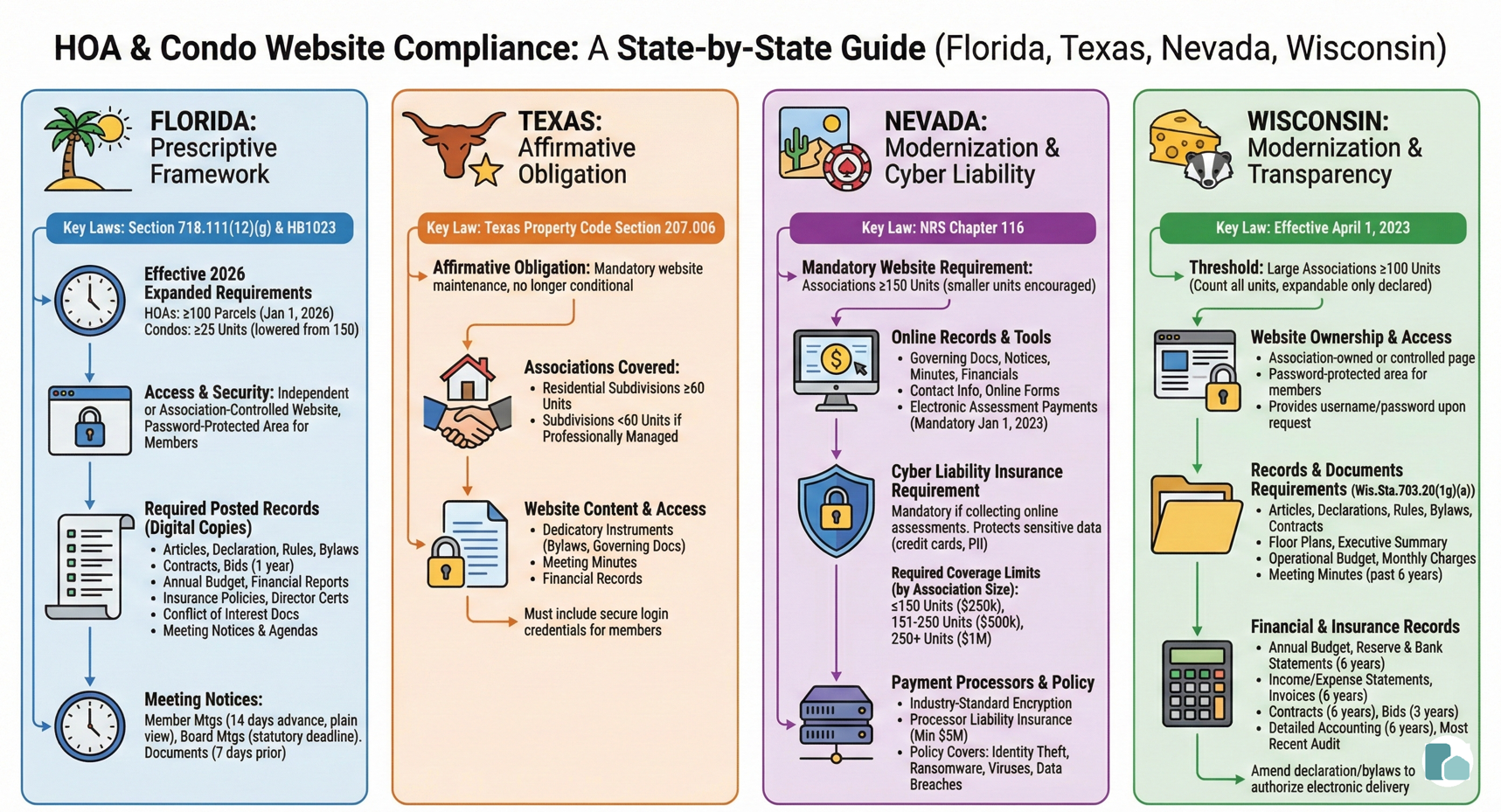
A recent Florida law, commonly known as HB 1023, requires HOAs with 100+ parcels to have a mobile app or a website. And now starting January 1, 2026, condominium associations with 25 or more units are required to have a website. This is actually a dramatic expansion for condominium associations, bringing the threshold down from the 150-unit threshold that has been in place since 2019 to 25 units. 

The law goes a step further and clarifies which records should be accessible through the website. The records include documents related to the association formation, bylaws and rules, contract documents, meeting notices, director certifications, and financial records. Note that this law took effect on January 1 this year. 

Texas Property Owners Association website requirements

Texas takes a specific approach for Property Owners Associations. Those with more than 60 lots must create a publicly accessible website featuring governing documents. The association should also make annual budgets, board meeting notices, and policy documents available online. 

Also, the website should keep contact information current for both the association and the management company. Associations that fail to meet these requirements face fines or homeowner lawsuits. In my experience, the public accessibility component is what catches boards off guard, as certain information must be available to anyone who visits your site.

Nevada’s strict HOA transparency standards

Nevada sets particularly rigorous HOA transparency standards and has found that communities there need to be especially diligent. Associations in this state must: 

  • Provide secure access to records, financial statements, and meeting agendas. 
  • Include a publicly viewable section for major HOA announcements and notices. 
  • Protect home data through secure storage with access limited to authorized members only. 

These Nevada regulations aim to enhance financial and operational transparency, helping to minimize conflict between board members and homeowners, something I have seen work effectively when implemented properly.

Essential documents homeowners must access

From my years as a community manager in the property management industry, I can tell you that HOA members generally hold the right to review and copy the association’s official records. You will typically find this right established in a state law, the HOA’s governing documents, or both. 

The specifics, however, differ by state. Some have detailed record inspection laws, while others keep things minimal. Your association’s governing documents also address members’ right to examine and duplicate records. Look for this information in your CC&Rs or the declaration. These documents often specify which records are available for viewing and copying. 

Many associations must also respond to record requests within specific time frames. I have seen boards get into trouble when they miss these deadlines. Which documents qualify as official records also varies by state. Some states provide an explicit list of records that must be available, while others use broader language. That said, based on my governance-focused perspective and practical experience, HOA members should have access to these documents and reports:

  • Financial records: The association’s accounting records and financial information, including complete accounting records with expenditure and receipt records, individual member account ledgers, financial reports, financial reviews, audit, and invoices. 
  • Governing documents: Articles of incorporation, declaration of covenant, conditions, and restrictions, bylaws, community plats and maps, and any amendments to these foundational documents.
  • Developer materials: All materials from the developer, such as land surveys and permits.
  • Rules and operations: Current rules and regulations that govern day-to-day community life.
  • Meeting documentation: Minutes from every board and membership meeting, along with notices for all board and membership meetings.
  • Insurance contracts: The association’s insurance policies, vendor contracts, and agreements with third parties.
  • Legal documents: Copies of liens, judgments, and encumbrances involving the association. 
  • Election materials: All election-related documents for board members, like directors and officers, including proxies, ballots, and voting materials.
  • Membership information: membership roster with mailing addresses and telephone numbers.

In my experience, confusion about which document should be accessible causes more conflict than almost anything else. When you are transparent about what is available and make it easy to access, you prevent a lot of headaches down the road.

Creating a compliant, effective HOA website

Now that you understand what transparency law requires, your HOA needs a method of providing residents with these documents. Even if your state hasn’t passed specific HOA website legislation, but does require transparency, establishing a website gives you an excellent way to share these materials and fulfill your legal obligations. Here is what I have learned works best:

Managing your documents

Your HOA website serves as an ideal repository for documents that residents have the legal right to review. I always recommend storing your CC&R rules, board meeting minutes, and financial statements where they are readily accessible. 

However, not all documents should be public. Implement a login system for restricted materials. Here is something I have seen work particularly well: consider limiting access to certain or all documents to residents who are currently on their dues. This creates a practical incentive for payment while maintaining compliance with the transparency requirements.

Building a resident portal

The most effective HOA websites I have worked with serve dual purposes. They work for both current residents and prospective homeowners. Your current community members need efficient ways to handle HOA-related tasks, including checking account balances, submitting service requests, and retrieving important documents. An integrated online portal makes all these possible. 

For example, the integrated portal allows members to gain immediate access to needed information and to complete necessary tasks through the integrated resident portal. This makes a huge difference when it comes to resident satisfaction. For security, each homeowner requires their own password-protected account, with board members maintaining the ability to manage these accounts. This is non-negotiable from both a legal and practical standpoint.

Creating a community calendar 

If your HOA stays active, a website calendar becomes an invaluable tool. In my experience working with boards, modern families juggle increasingly busy schedules, so having a centralized reference point for upcoming events proves extremely helpful. 

Include HOA meetings, community events, and project schedules with specific dates and times. Here is a feature I always recommend: when residents subscribe to this calendar, your association’s important dates automatically appear on their personal calendars, such as Google Calendar or Mac Calendar. This simple integration dramatically improves attendance at meetings and events.

Establishing communication channels

Since your HOA website functions as a central hub for all community-related matters, it should facilitate communication between members. Well-designed websites I have worked with include forums where members discuss topics ranging from gardening advice to questions about HOA rules. 

Top-tier HOA websites also feature dedicated announcement sections. This approach saves both time and money for the association, while enabling immediate information sharing. I have seen associations cut their printing and mailing costs substantially by shifting to digital announcements.

Implementing polling features

While not mandatory, polling capability adds significant value to your HOA website. It streamlines voting procedures, removing the need for in-person voting. Naturally, your polling features should include safeguards, such as ensuring homeowners can vote only once. From my governance-minded perspective, this is where technology really shines in supporting proper HOA operations. You can conduct surveys, gauge interest in proposed changes, and even handle certain types of votes, all while maintaining a clear audit trail.

Setting up amenity reservations

Some homeowner’s associations, particularly those with thousands of members, limit the number of people who can use each community’s amenities simultaneously. Rather than managing this through phone calls, which I can tell you from experience is a nightmare, you can automate amenity reservations through your HOA website. This feature should include automatic wait list functionality and require residents to accept common area rules before finalizing each reservation. 

Integrating online payment processing

Here is something I learned early in my career as a community manager: Collecting monthly dues ranks among the most demanding aspects of HOA management. Your association has probably relied on mailed checks, then tracked who paid and who didn’t, month after month after month. It is exhausting and error-prone. 

Good HOA websites incorporate online payment portals where residents can pay dues and fees through their user accounts. This integration not only satisfies your residents but also significantly simplifies your treasurer’s responsibilities, making it easy to identify who has paid and who is late, send payment reminders, and generate reports quickly. 

Final Thoughts

From a technical standpoint, a homeowners’ association website should prioritize information delivery above everything else. Why is this the case? In my years supporting self-managed HOAs, one of the most significant obstacles these associations encounter is distributing information efficiently. In some cases, associations hire property management companies specifically to improve information management and distribution processes. I have been on both sides of that equation, and I can tell you that a well-designed website can give self-managed communities many of the same advantages. 

An HOA website makes it feasible to deliver essential information even in communities with hundreds of members, thereby satisfying the transparency requirements of the law. For instance, you can include a community calendar section that provides event details and helps owners track important dates. You can also create a secure online directory where homeowners access documents they are legally entitled to view. 

When your directory automatically generates from information residents provide during sign-up, you can trust that your information remains accurate and that only association members gain access. This design ensures your website complies with the state-specific requirements, such as maintaining protected areas for sensitive information. Here is what I have learned: transparency isn’t just about following the state laws; it’s about building trust. When homeowners can easily access the information they need, when they can see how their money is being spent, and when they feel included in the process, your entire community benefits. That is the main benefit of getting your HOA website right.

2026 HOA website compliance guide state-by-state

{get_the_title()}

2026 HOA website compliance guide state-by-state

In my years working with HOA boards across the country, I’ve watched the shift from paper notices pinned to physical bulletin boards to digital platforms happen almost overnight. And honestly, it has been a game-changer. Homeowners now have 24/7 access to governing documents; they can check event calendars, view meeting agendas, and find contact information whenever they need it. No more waiting for the monthly newsletter or hoping they caught that notice taped to the clubhouse door. 

Most associations I work with structure their website with two levels of access: public-facing pages that display general community information, and a password-protected section for homeowners only. That protected section houses sensitive materials like CC&Rs, bylaws, rules and regulations, and internal records such as the Annual Policy Statement and Annual Budget Report. Some communities have even added interactive bulletin boards where residents post notices and discuss community matters.

But here is where it gets tricky: legal requirements vary dramatically by state. Some states mandate exactly what type of information can be posted on public pages versus what requires login credentials. Other states remain completely silent on the issue, with no direct laws addressing HOA websites at all. 

When associations integrate bulletin boards into their website, many boards want to pre-approve notices or have the ability to edit or delete posts, especially to control situations where homeowners might post inappropriate content. I have had board members asking me about this more times than I can count. The problem is, the board doesn’t have that much freedom. There are illegal requirements around this as well that you need to understand. 

In this guide, I will walk you through the 2026 HOA website compliance requirements state by state, so you know exactly what your association must do. I will also explain the legal requirements around bulletin boards and which content the board isn’t allowed to edit or delete.

States that mandate HOAs to have websites

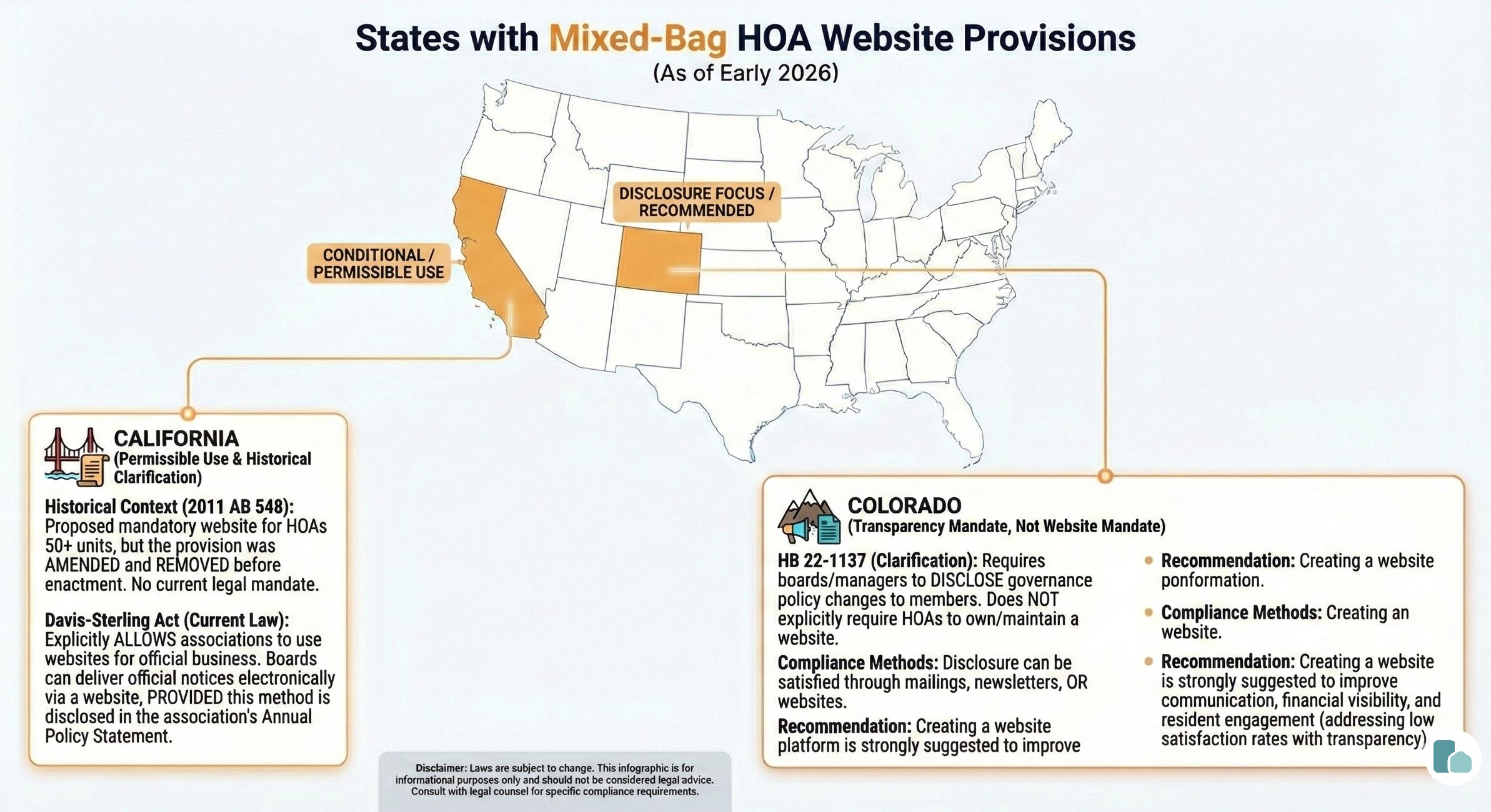
Over the years, several states have enacted laws that directly address HOA and condo association websites. California was one of the earliest states to formally tackle this issue. In 2011, the state passed Assembly Bill 548, which initially required HOAs with 50 or more units to have a website containing specified association information, unless two-thirds of the membership voted to opt out. 

However, the mandate was later amended, and the blanket website requirement was ultimately removed. Even so, California laid the groundwork for the compliance-driven website requirements we see today. For the following states, having an association website is a must, although some have a conditional threshold based on association size before the website becomes a legal requirement.

Florida

Florida has one of the most prescriptive HOA and condo website compliance frameworks in the country. In 2017, the state passed Section 718.111(12)(g), requiring condominium associations with 150 or more units, excluding timeshare condominiums, to post specific association records online. The statute clearly detailed rules around the website where those records must be made available. For a website to be compliant in Florida, it must be:

  • An independent website owned and operated by the association, or 
  • A website or a web portal operated by a third-party provider where the association owns, leases, rents, or retains the right to operate a dedicated page for association business. 

The main reason behind this requirement makes perfect sense: if the association switches management companies, it keeps the website. That means there is never a time when the association loses its online presence and associated records simply because the previous manager owned the domain. Even without a legal requirement, I still strongly recommend doing this because I have previously seen boards scramble when they lost access to their entire digital history during a management transition, and it is never pretty.

Access and security requirements

The website must be accessible through the internet and include a portion that is not accessible to the general public. Compliance requires a password-protected area accessible only to homeowners, association board members, and employees. The protected area can be a subpage, portal, or any other electronic secure location.

Expanded requirements effective 2026

Florida has now broadened its digital access requirement for HOA websites with the passage of HB1023. Starting January 1, 2026, HOAs with 100 or more parcels must make specified official records available through an association website or mobile application. At the same time, Florida continues to lower the unit count threshold for condominium associations. Since 2019, condominium associations with more than 150 units have been required to maintain a compliant website. But beginning this new year, 2026, this requirement expands to cover associations with as few as 25 units. This dramatically increases the number of communities subject to website compliance laws.

Records that must be posted

To remain compliant, covered Florida condominium and homeowners associations must post digital copies of the following records on their association website or mobile application: 

  • The articles of incorporation and all amendments 
  • The declaration of covenants and all amendments
  • The current rules of their association
  • The recorded bylaws and all amendments
  • A list of all current executory contracts and documents to which the association is a party, or under which the association or parcel owners have an obligation
  • After bidding closes, a list of bids received within the past year for materials, equipment, and services will be provided.
  • Annual budget or any other budget proposed to be considered at the annual meeting
  • The association’s current insurance policies
  • The financial report and any monthly income and expenses statements are to be considered at a meeting
  • The certification of each director as required by section 720.3033(1)(a) 
  • All transactions and contracts between the association and any director, officer, corporation, firm, or entity in which a director has a financial interest, and that is not an affiliated homeowners association
  • Any contract or document involving an actual or potential conflict of interest under Sections 468.436(2)(b) and 720.3033(2) 
  • Meeting notices and agendas 

Florida also places strict timing and visibility requirements on meeting notices:

  • Member meetings: Notices and agendas must be posted at least 14 days in advance. The notice must appear in plain view on the website homepage or on a clearly labeled “Notices” page linked from the homepage. Any document to be listed on the agenda or to voted on needs to be posted at least 7 days before the meeting.
  • Board meetings: Notices, agendas, and required supporting documents must be posted no later than the statutory notice deadline under Section 720.303(3). 

As with other required documents, these meeting-related materials must be accessible through a protected area of the website or mobile application.

Texas

In Texas, HOA and condo website requirements are governed primarily by the Texas Property Code. This code regulates how residential subdivisions and townhome associations are created, operated, and managed. 

Historically,Section 207.006 of the Texas Property Code only required an association to post its dedicatory instruments online if the association or its management company already maintained a website. That meant many communities avoided website obligations entirely by simply not operating one. But that approach has now changed. The Texas legislature amended Section 207.006 to require most townhome communities and residential subdivisions to maintain a website accessible to their members. This change shifts the law from a conditional requirement to an affirmative obligation.

Associations covered

  • Residential subdivisions with 60 or more units must maintain a website 
  • Subdivisions with fewer than 60 units are exempt unless the association is managed by a professional management company. That means if a management company is involved, the website requirement applies regardless of the association’s size.

Website content access

Texas law continues to require that all dedicatory instruments be made available on the association’s website. These include documents such as:

  • Bylaws and governing documents
  • Meeting minutes
  • Financial records 

The website must be accessible to members and include secure login credentials to protect sensitive association information.

Nevada

Nevada regulates condominiums and homeowner associations under the Common-Interest Ownership Act, codified in Chapter 116 of the NRS. This chapter has been updated to reflect modern expectations around digital access and transparency.

Mandatory website requirement

The amended Section NRS 116.31069 mandates that any association with 150 or more units must establish and maintain an electronic portal or secure internet website accessible to owners. Associations with 150 units or fewer are encouraged to maintain a portal or website, but are not legally required to do so.

Required online records

For associations that meet the threshold, the website or electronic portal must make available documents relating to the association, including: 

  • Governing documents: CC&Rs, bylaws, rules, and regulations 
  • Meeting notices: Timely posting of notices and agendas so homeowners are informed of upcoming meetings and decisions 
  • Meeting minutes: Published minutes allow owners to review board discussions and actions 
  • Financial records: Financial statements, budgets, and reports to promote financial transparency

Communication and administrative tools

Nevada law also recognizes the website as a functional administrative tool. Compliant association websites need to include: 

  • Contact information for board members, management, and committees 
  • Online forms allowing owners to submit requests and questions for better association communication

Electronic assessment payments

Modernization of NRS 116.31069 took effect on January 1, 2023. Associations subject to the website requirement must ensure their portal or website supports electronic payment for HOA assessments. The requirement seeks to improve association efficiency and resident convenience.

Cyber liability insurance requirement

Nevada has gone a step further than most states by tying HOA website use directly to insurance requirements. In 2023, the Nevada Legislature enacted a law requiring community associations to carry cyber liability insurance if they use an electronic portal or website to collect assessments online. 

This requirement is directly tied to the online payment requirements and the risks involved. When you are collecting assessments online, the portal stores sensitive data like credit card information, bank account numbers, and other personally identifiable information, such as usernames, passwords, email addresses, names, and addresses. This data is highly attractive to cyber criminals.

Required coverage limits by association size

  • 150 or fewer units: minimum coverage of $250,000
  • 151 to 250 units: minimum coverage of $500,000
  • 250+ units: minimum coverage of $1,000,000

Payment processors and data security

Nevada law also regulates third-party payment processes. If an association contracts with a processor to collect assessments, the processor must: 

  • Use industry-standard encryption and data protection measures 
  • Carry cyber liability insurance with a limit not less than $5 million

Policy coverage

The association’s cyber liability policy must cover losses arising from: 

  • Identity theft 
  • Ransomware 
  • Computer viruses 
  • Data breaches
  • Unauthorized system access 
  • Other cyber-related exposures

Wisconsin

Wisconsin has joined states like Florida in modernizing association law to reflect current communication practices and transparency expectations. Effective April 1, 2023, Wisconsin law requires large associations to build and maintain a website. Generally, an association is considered large if it contains 100 or more units.

Website ownership and access requirements

Covered associations must maintain a website that meets the following criteria: 

  • The site must be accessible through the internet 
  • The site must have a password-protected area that all members of the association can access, but not the general public 
  • The association must own and operate the site. If a third-party provider operates the website under a contract, that contract must give the association control over a web page dedicated exclusively to association activities 
  • Upon written request from a homeowner, the association must provide a username and password

Records and documents requirements

The association must post current copies of documents, notices, and records that homeowners are entitled to inspect under Wis.Sta.703.20(1g)(a). Here are the records that the website must include:

  • The articles of incorporation, declarations, rules and regulations, bylaws, employment, management, and other contracts affecting the access, use, and maintenance of the community 
  • Floor plans showing common elements and facilities available to homeowners, identifying which areas are parts of the association and which are owned by others 
  • The yearly operational budget and monthly charges for the lease, rental, or use of amenities that are not part of the association 
  • Meeting minutes and documentation of activities undertaken without a meeting in the past 6 years 
  • An executive summary meeting the formatting and content guidelines required by the statute

Financial and insurance records

  • Annual budget, reserve account statements, bank statements, and financial statements from the past 6 years 
  • Income and expense statements from the past 6 years 
  • Invoices and expense records created within the past 6 years 
  • Contract entered within the past 6 years, including bids received within the past 3 years 
  • Detailed accounting documents showing expenditure receipts from the past 6 years 
  • The most recent financial audit, if any, regardless of when the audit was conducted

Unit count considerations and governing documents

The statute doesn’t differentiate between storage units, parking units, or residential units when determining whether the community meets the 100-unit threshold. To be on the safe side, I recommend counting all units. For expandable condominiums, only the units that are currently declared are included. Additionally, the association needs to amend the declaration and bylaws to formally authorize the delivery of official records and notices, such as payment reminders and bills, through the website and portals.

States with mixed-bag website provisions

Not every state takes a hard-line approach to HOA website requirements. Some laws are frequently misinterpreted as website mandates when, in reality, they focus on disclosure methods, permissible usage of online tools, and transparency. California and Colorado are good examples.

California 

California’s website requirements are a mixed bag. In 2011, California introduced Assembly Bill 548, which proposed a requirement for HOAs with more than 50 units to maintain a website. Some secondary sources still claim this bill became law. However, in my research, I found that the bill was amended before enactment, and the mandatory website provision was ultimately removed. As a result, California HOAs are not legally mandated to have a website. 

That said, the Davis-Sterling Common Interest Development Act, which governs California HOAs and condominium associations, explicitly allows associations to use websites for official association business. It allows boards to deliver official notices electronically through a website, as long as this method of delivering information is already disclosed in the association’s Annual Policy Statement.

Colorado

Colorado presents a similar situation. Some sources claim that Colorado House Bill 22-1137 requires HOAs to create and maintain a website accessible to all owners. But that is not what the statute actually does. When I went through the statute once again, I found that the law focuses on governance transparency, not website ownership. 

HB 22-1137 requires boards and community association managers to disclose changes in governance policy to community members through mailings, newsletters, and websites. In short, the law mandates transparency, but it doesn’t explicitly require HOAs to maintain websites. You can satisfy the disclosure requirement through printed mailings if you choose. 

However, I recommend creating a website platform where members can view upcoming events and the association’s financial status. In a recent study I conducted across community associations, I found that only 38% of residents in condominium associations feel informed of board decisions. In HOAs, 32% of residents are not satisfied with the financial visibility the board provides. So, if you want to run an engaged community where nobody feels left out, I strongly suggest you invest in a website to improve communication and transparency.

ADA compliance

As with any public-facing service, places that HOAs use to host general public events must be ADA accessible. These include parking areas, meeting rooms, and clubhouses. Failure to address accessibility can expose an association to regulatory enforcement, fines, and lawsuits. Recent ADA updates have increased penalties and, in some cases, require medication and alternative dispute resolution before litigation. 

As expectations around digital accessibility continue to rise, I recommend that HOAs evaluate their websites, mobile applications, and portals to ensure they are accessible to individuals with disabilities. Some best practices I recommend include:

  • Screen reader compatibility 
  • Closed captioning for videos 
  • Keyboard navigation support 
  • Alternative text for images 
  • Sufficient color contrast for text

Electronic bulletin boards

If you’re considering integrating an electronic bulletin board into your website, I recommend understanding the liability landscape around it, especially when it comes to free speech. Courts don’t treat online bulletin boards the same way they treat traditional media like newspapers and radio stations. Entities that provide access to internet bulletin boards are granted broad immunity from liability for user-generated content, and online speech is protected under the First Amendment. 

Here is what you need to understand: if the association allows candidates or members to use website bulletin boards during an election, equal access rules apply. If one candidate or group advocating a position is given access for election-related communications, the same opportunity must be extended to:

  • All candidates
  • Members advocating opposing viewpoints
  • Individuals not endorsed by the board

The association is not allowed to edit, redact, or restrict these communications. However, the association can include a disclaimer stating that the candidate or member, not the association, is responsible for the content. 

In short, you cannot restrict candidates’ statements on a bulletin board or edit a member’s election-related statement. The moment the association integrates the bulletin board into the website and opens the forum, you have created a public space with constitutional protections.

Moving forward

Beyond the state mandates, I have seen and experienced how association websites create stronger communities. Instead of printing meeting notices and hoping residents see them on traditional bulletin boards, post them on your website with a link to the agenda and an RSVP form. Track attendance, reduce paperwork, and improve engagement. 

State legislatures continue adding website requirements, with some reducing the size of the threshold for website mandates. Moving forward, it seems that transparency through digital access is becoming the standard. My advice is this: instead of waiting for your state to mandate compliance, implement a website now. Build it with ADA accessibility from the start. You will avoid the scramble when legislation passes website mandates or ADA compliance laws, and you’ll serve your community better in the meantime.

Nevada HOA website requirements 2026 – What you need to know

{get_the_title()}

Nevada HOA website requirements 2026 – What you need to know

Most states don’t legally require HOAs to maintain a website; however, Nevada does. What does that mean for your community? And can you just use Facebook instead?

We address those questions, and offer some best practices for building and maintaining an HOA website, in this article.

Table of contents

Most HOAs in Nevada are legally required to maintain a website

Common interest communities (otherwise known as HOA and condo associations) in Nevada with 150 units or more are required, by law (NV Rev Stat § 116.31069), to have a website or electronic portal that is accessible to all owners.

This law is not new. It was passed in 2021 and came into effect on January 1, 2023.

Below is a more detailed overview of the website law:

CHAPTER 116 – COMMON-INTEREST OWNERSHIP (UNIFORM ACT)

Establishment and maintenance of an internet website or electronic portal

Each association of a common-interest community that contains 150 or more units shall establish and maintain a secure internet website or electronic portal that may be accessed by any unit’s owner.

The association shall make available on the website or within the electronic portal the following documents:

      (a) The governing documents

      (b) The annual budget of the association and any proposed budgets

      (c) The notices and agendas for any upcoming meetings of the association

So, in addition to having a secure website or portal, the HOA must have the association’s governing documents, annual budget and proposed budgets, and notices and agendas for upcoming meetings.

Only a few states have HOA website requirements at this time; however, more states could reasonably implement similar laws since the impact of having such a mandate is overwhelmingly positive for owners and HOAs as a whole.

Owners can make online payments through a website – provided certain requirements are met

The same set of laws also addresses online payments. The HOA website or portal may provide owners with the ability to pay fees or dues electronically only if:

(a) The association or payment processor maintains a policy of cybersecurity insurance in a minimum aggregate amount of $5,000,000 that provides coverage for potential losses associated with the unauthorized acquisition of personal information provided to process payments through the website or electronic portal, including, without limitation, losses caused by identity theft.

(b) For an association that has contracted with a payment processor that maintains a policy of cybersecurity insurance described in paragraph (a), the association must still hold its own policy of cybersecurity insurance in a minimum aggregate amount of:

  • $250,000 for associations with 150 or fewer units
  • $500,000 for associations with 151 – 249 units
  • $1,000,000 for associations with 250+ units

(c) The website or electronic portal allows the association or payment processor to suspend an owner’s ability to make a payment through the site or portal if past due obligations are assigned to a third party for collection.

(d) The association or payment processor complies with the requirements of NRS 603A.010 to 603A.290, inclusive, with respect to any personal information collected through the website or portal.

(e) The board has conducted an evaluation of the costs and benefits of providing owners the ability to pay fees online.  

In summary, the board must evaluate whether it’s in the association’s best interest before introducing online payments through a website or portal. That includes assessing the costs of cybersecurity insurance.

What if my community has fewer than 150 units?

Smaller condos and HOAs with fewer than 150 units are encouraged to have a website or portal, but are not legally required to maintain one.

You do not need a website if your Nevada HOA has less than 150 units.   

Why does my HOA need a website?

Lawmakers generally pass website legislation to help improve transparency, trust and engagement within community associations.

Owners have a right to view records

Sometimes, owners find it difficult to obtain important information such as budgets, policies or meeting details. Replies from management might be too slow, or their requests are altogether forgotten.

The important thing to highlight here is that, with a few exceptions, owners have a right to see HOA records.

Putting them online helps to ensure those records are readily available. Moreover, staff don’t have to spend time looking for physical records, and owners don’t need to pay photocopying or retrieval costs.  

Communities are more organized

A website or portal serves as a single, authoritative source for community information. Most people find it more convenient to get on a computer or smartphone to look up something than to physically go to an office and ask someone for that same information. With a user-friendly website, owners know exactly where to go to find what they need.

Websites can be tailored to provide more than the required information, too. Adding links to forms, amenity hours and rules, and contact information for preferred vendors, promotes smoother operations and reduces frustrations.

Furthermore, HOAs websites ensure everyone has access to the same, up-to-date information, effectively minimizing misunderstandings and confusion.  

Reduced workload for the board and management

Some admin work, such as collecting payments, manually processing maintenance requests, and responding to routine inquiries, can be drastically reduced with the help of website automation.

Less busy work means your board or manager has more time to focus on high-level work.   

Why can’t we just use Facebook?

Virtually every HOA has an unofficial Facebook group, and that’s not a bad thing. Owners can share announcements or information from the board with others, have discussions with their neighbors, and even sell items using a social media platform.

But, this is not the tool for community management, and any HOA attorney will advise boards to stay far away from Facebook and other social media groups.

There are a few reasons for this. For starters, it’s not easy for an HOA to control the narrative, especially if owners have the option to post anonymously. People often use this platform to complain, and conversations can escalate quickly. Board members should not be engaging in these conversations. Doing so can expose the community to liability issues, or, at the very least, create additional conflict between the board and other members.  

Social media platforms aren’t designed for organizing and storing important documents like bylaws, CC&Rs, budgets and meeting minutes in an easily accessible way. HOA websites, on the other hand, are designed for HOA-specific requirements.

Finally, social media platforms can change their policies at any time without requiring consent from users. These platforms don’t offer the level of security required for sensitive HOA documents and communications.

Tips for building and maintaining an HOA website

Perhaps your HOA didn’t need a website, but is interested in building one now. Or, maybe it’s time to get a site that better serves the community’s needs.

Regardless of your experience with HOA websites, these tips can help you find a solution that meets your needs and your budget.

Make a list of your HOA’s requirements and wishes

Your HOA website should be as unique as your association.

In addition to necessities, such as having a password-protected section for owners and a place to store documents, consider what features or functionalities you could include to improve communications or reduce the workload for staff and the board.

Many HOA-specific platforms go beyond the basics and can support online payments, maintenance request management, voting, classifieds, and more.

Your owners might not need so many extras, and that’s okay too. Just make sure the features that you do select are useful to owners and staff.    

Determine if a DIY or professional website design option is best

Website builders like Wix, Squarespace, and WordPress are popular and well-loved by businesses and individuals alike.

DIY platforms are almost always the more affordable choice. Bu,t the HOA needs to ensure that someone has the skills and the time to build the website.

The other option is to pay a company to build the website for your HOA. Since the website is customized, the price range can vary quite a bit depending on complexity, design, and the number of web pages.

HOA Sites balances professionalism with affordability.

HOA Sites provides HOA communities with a platform that makes it easy for them to build their own sites. However, the templates they offer are not mass produced. Instead, the company’s web designers build custom templates for every community.

With access to over 60 features, HOA Sites goes well beyond the standard HOA website. And the price is hard to beat.

People who feel a bit uneasy about putting together a website will be relieved to know that HOA Sites always provides a Personal Project Manager. This person offers suggestions and their expertise throughout the entire building process. That way, you can complete your HOA site with confidence and precision.    

Ensure your board or manager can make easy updates

Since documents and event dates require frequent updates, it’s best if someone from the board can make those changes on the site by themselves. If you need to call a developer every time a meeting notice needs to be posted, you might end up paying more than you planned to.

Keep mobile usage in mind

Owners will be using the website from their smartphones. It’s important to make sure that the platform is mobile-friendly and provides owners with a smooth experience.

Evaluate how much you can spend annually to maintain your website

In addition to paying a one-time fee to build a website, the HOA will need to pay recurring fees to keep it up and running. Costs may include domain name registration, web hosting, the SSL certificate, and plugins and premium addons.

Little costs can add up, so ask about recurring costs before you agree to anything.

Conclusion

If your HOA is in Nevada and has 150+ units, then it is legally required to have a website. While this isn’t a new law, it can be helpful for HOAs to understand why the law was passed and what it aims to achieve.

If your HOA is smaller, but you’re thinking about getting a website to manage communication and documents, give it a try! You might be surprised by how quickly your site generates traffic.

Can you really restrict big dogs in an HOA?

{get_the_title()}

Can you really restrict big dogs in an HOA? Plus other common pet policies

Dogs are treated like (or better than) family in pet-friendly households.  But not everyone feels such affection for these four-legged friends.

Unfortunately, it’s usually bad owner behavior, and not bad dog behaviour that causes pet-related conflicts within HOA communities.

Pets are one of the main issues that HOAs encounter. It’s usually dog waste that creates problems, but complaints about barking, and aggressive behavior, are also received.  

That has led some associations to ask if they can ban dogs, or at least big dogs, from the community.

Though the matter is more complicated than many would think, it can be hard for a community to enforce this type of rule.

Table of contents

Can HOAs restrict all pets?

Yes, but it is not recommended. While this type of rule eliminates any grey areas, outright bans on pets are hard to enforce and can face challenges under the Fair Housing Act (FHA).

California HOAs cannot try to enforce such a rule. According to California Civil Code Section 4715, “No governing documents shall prohibit the owner of a separate interest within a common interest development from keeping at least one pet within the common interest development, subject to reasonable rules and regulations of the association.”

Under this law, a pet means any domesticated bird, cat, dog, aquatic animal kept within an aquarium, or other animal as agreed to between the association and the owner.

Can HOAs restrict big dogs?

Yes. Unless there are laws that state otherwise, HOAs can place restrictions within pet policies.  Restrictions may target the size, total number, or breed of pets. 

These limitations must be stated in the community’s governing documents, and are intended to maintain harmony and safety for all residents. 

If a size limit exists, it is usually in the form of a weight limit. For example, owners and residents cannot have dogs that weigh more than 50 pounds.

Why restrict large dogs? Some think it’s because they expel more waste, creating more mess. Others who are concerned about safety may argue that bigger dogs are harder to control, and have the potential to inflict greater harm.

Though these arguments are valid, there is a growing belief that it makes more sense to regulate behavior as opposed to size or breed. After all, good dogs come in all shapes and forms.

Can HOAs restrict certain breeds?

Yes, and breed-specific legislation (BSL) exists in multiple states. For example, in Arkansas, Indiana, Iowa, and Kentucky, pit bulls are still subject to legal restrictions.

Other common HOA pet policies

Pet polices differ depending on the needs of the association. The goal is to make the community a happy and safe place for everyone. That can be a tough thing to do, but HOAs use some of these additional policies to try and strike that balance:  

  • Limit on the number of pets allowed per household. Often, that number is 2 or 3
  • Reasonable restrictions when it comes to the type of pet that can be housed. You might be surprised by the types of animals people have tried to keep as pets
  •  Leash, control, and common-area rules. This is very important to promote and enforce
  • Waste cleanup and sanitation. Include information about what happens for noncompliance so that owners are aware of the consequences
  • Noise, nuisance, and aggressive behavior. Define what counts as a “nuisance” or “aggressive behavior,” as well as what happens if a pet has been aggressive around other members (warnings, fines, removal)
  • Clearly identify any pet-free zones or restricted areas, including pools, playgrounds or the clubhouse
  • Clearly identify any amenities or infrastructure designed for pets (dog parks, waste stations)
  • Clearly list registration, identification, and vet record requirements. Some HOAs require registration, proof of vaccination and tags
  • Details about liability, insurance, and indemnification. State whether pet owners are responsible for costs associated with damage, injury, or biting

Ensure that policies are up to date and easy to access. Storing them on the HOA’s website allows owners to review them at any time, from anywhere.

A quick note about grandfathering

While consistency is important when it comes to enforcing any community rules, sometimes, things change.

Rules and policies need to be updated from time to time as circumstances and expectations change. However, if implementing those changes could have a negative and serious impact on existing members, the HOA board may choose to include a grandfather clause.

This means the new or revised rules do not apply to existing members unless their situation changes.

In the context of pets, an HOA may decide to place a limit on the number of pets one household can have at any given time. Let’s say that number is 2. However, a small group of owners already have 3 pets.

Instead of asking those people to find a new home for one of the pets, the HOA will use a grandfather clause that exempts them from the new rule. They can keep all of their existing pets without issue.

However, these owners are not permitted to have more pets, and if one of the pets passes away, they cannot get a new one. Once their situation changes, in this case, a pet passes away, they must follow the new rules.   

Eventually, the board will be able to phase out the grandfather clause once the change or amendment is enforceable to all members.

What about service dogs?

The Fair Housing Act protects people from discrimination when renting, buying, or financing a house, and when pursuing other housing-related activities. Under this federal law, people with disabilities can request reasonable accommodations from their associations. This includes the right to have a service animal.

HOAs cannot enforce breed or size restrictions on a service animal. However, the HOA still has the right to require that the owners of these animals follow the rules. That includes abiding by leash regulations, and following through with waste clean-up.

What about emotional support animals?

Emotional support animals are more complicated and will be addressed in another article. However, since a support animal is not a pet, an owner may be entitled to have the animal, even if the HOA has an established no-pet policy.

Associations cannot refuse to make reasonable accommodations when such accommodations may be necessary to afford an owner with a disability an opportunity to use and enjoy their home.

If an owner is requesting to keep a unique type of animal, for example, a pig, the burden is on the requester to demonstrate a disability-related therapeutic need for the animal. Associations should not rush to deny the request, but instead seek to gain credible information regarding the request.

Solutions to curb poor owner behavior 

Pet issues are not always easy to solve. Many communities struggle with pet waste issues simply because incidents occur quickly, and it can be very hard to prove that someone didn’t clean up when they should have.  

If general reminders and warning letters aren’t working, it might be time to try a more something more effective.

Install waste disposal stations

Having a place to dispose of waste will encourage owners to pick up after their pets during walks. If possible, provide bags at the stations so that owners really have no excuse for not cleaning up.

Enforce the rules whenever possible

If management or a neighbor knows who isn’t picking up after their pet, the association should notify the owner. Follow the association’s enforcement process to ensure fairness and consistency. Fines are generally a good way to get owners to change their behavior.

DNA testing

If pet waste is becoming the community’s main pain point, there are companies out there that will test feces and provide DNA results to the association. This is an expensive, but effective way to get owners to clean up after their pets.

The big catch is that dog owners must first provide the HOA with a DNA sample from their pets. Typically, all that is needed is a cheek swab, but some owners might be reluctant to participate in this program.

HOAs will also need to determine if testing costs will be charged back to the owners, or if this is something that comes out of the association’s budget.

Navigating HOA décor: Can you have lights up all year?

{get_the_title()}

Navigating HOA décor: Can you have lights up all year?

HOAs favor uniformity to maintain or enhance property value. For this reason, they create architectural standards and complementary rules so that homes are aesthetically pleasing to all.

While some owners may view the standards as limiting or bland, they prevent owners from disrupting neighbors with flashy light displays or loud animatronics. You won’t see outdoor Christmas trees on an HOA lawn in the middle of July.   

Most HOA members know that there are limits when it comes to traditional holiday decorations. But what about subtle white lighting or modest décor?

In this article, we’ll cover the general rules, plus get into more detailed elements of décor restrictions.

Table of contents

Why do HOAs need rules for holiday décor?

As discussed earlier, aesthetics are important to HOAs. They value uniformity, which is why they create limits on what owners can do when it comes to decorating their homes.

However, when it comes to the Fourth of July, Halloween, Thanksgiving and Christmas, this matter is rarely simple.

That’s because there is no “standard” for decorations. As a result, some communities will have very strict rules, while others will allow inflatable decorations on lawns or decorative reindeer on the roof.

You will need to refer to your HOA’s décor policy to find out how creative you can get when it comes to making your home look festive.

Common holiday décor rules

While the rules for décor vary quite a bit, many communities have similar time periods for holiday décor.

Owners may have permission to start decorating as early as 30 days before the holiday begins, and anywhere from 2 weeks to 1 month to remove décor after the holiday ends.

Size and placement are also addressed so that owners can enjoy holiday fun without going overboard. For example, if inflatable Santas are allowed, owners may be limited to 1 per household.

Most HOA decoration rules include restrictions regarding:

  • Noise – rules may limit the use of decorations that produce sound. This can include musical lights.
     
  • Size – some HOAs prohibit oversized inflatables, large displays, or items that could obstruct views or pose safety hazards.
     
  • Timing – there are timeframes for which holiday decorations can be put up and removed.
     
  • Color – certain color schemes may be required to maintain a uniform appearance.
     
  • Etiquette – HOAs typically prohibit offensive or inappropriate themes. Some Halloween décor might be too gory.
     
  • Location – restrictions can also apply to the placement of décor, limiting displays to doors and windows and not allowing anything on rooftops or trees.

Are there limits for religious symbols/décor?

This question can be harder to navigate, so always contact the HOA attorney if you have doubts.

The Fair Housing Act prevents HOAs from establishing guidelines that are discriminatory against any owner who observes or practices a particular religion.

For example, bylaws should never say that community members can’t display “Christmas decorations”, “Hanukkah decorations” or other decorations specific to a particular religious holiday.

Instead, bylaws might ban certain types of “holiday decorations or displays,” in general.

Boards may adopt reasonable rules limiting when owners can start decorating and how long decorations can remain up after the holiday has passed.

In California, according to Davis-Stirling, community associations cannot prohibit the display of religious items on entry doors and door frames (Civ. Code § 4706). These can be displayed permanently.

In this instance, a religious item is defined to mean an item displayed because of sincerely held religious beliefs. Religious symbols that qualify include the Jewish Mezuzah and the Christian cross. Davis-Stirling adds that Christmas wreaths and lights would not likely qualify as religious symbols.

Associations can impose some limitations to prevent these symbols from:  

  • threatening public health or safety
  • hindering the opening or closing of any entry door
  • violating any federal, state, or local laws

Displays cannot be more than 36 by 12 square inches, individually or combined.

Religious symbols and displays may be permitted year-round, but there will be limitations as to where they can be placed and how large they can be. Always check rules and bylaws first to see what limitations apply to your HOA.

What about subtle lighting?

Permanent, programmable, exterior LED lighting systems, Trimlight being one of the most popular options, are designed for year-round use. 

These systems are installed along the roofline of the home and allow for customizable, color-changing displays for holidays, special events, or general aesthetic enhancements. 

This type of system might be allowed, but you should check for any light-specific policies first, as rules can differ significantly depending on your community. Furthermore, your HOA probably won’t permit you to display green and red lights in the middle of summer, but this would be okay around Christmas time.

Many U.S. HOAs do not address outdoor lighting requirements. However, those that do tend to focus on preventing light trespass, which is a condition where light originating from one property is received on another. If your HOA is silent on this issue, consider making guidelines for your owners.

Some HOA lighting rules may include timing schedules for lights to be on. For example, the exterior lights must be turned off at 11 p.m. While that rule doesn’t prevent light from trespassing onto another property, it at least prevents owners from being exposed to too much light late a night.

Décor policies should be clear and reasonable

The best way to ensure HOA owners follow décor and lighting rules is to:

  1. Establish clear, specific rules that address timeframes, location and size. Ambiguous policies lead to confusion and misunderstandings. Plus, it would be very unfortunate for someone to spend a lot of money on something only to later find out that they can’t have it in their front yard.
  2. Make sure those rules can be accessed with ease. This is where having a website comes in handy. By sharing rules or policies on a password-protected section of your HOA site, you ensure everyone has the most current information at their fingertips without first having to request it from you or your staff.

When everyone knows what’s expected, misunderstandings and violations are minimized, and the holidays can be celebrated as they were intended.

Associations are encouraged to find a balance between maintaining an aesthetically pleasing environment and allowing owners to enjoy the holidays. Remember that rules can be amended if they are no longer relevant or useful.

Rules that are not in writing cannot be enforced.

Finally, be prepared to enforce the rules. If there are no consequences for ignoring rules, owners have no real reason to follow them.

Texas’ HOA website requirements 2025 – What you need to know

{get_the_title()}

Texas’ HOA website requirements 2025 – What you need to know

Big belts, big hats, and big attitudes. Things tend to be bigger in Texas. But when it comes to HOA websites, size doesn’t matter.

Whether your community has 100 members, or 4,000 members, Texas HOAs need to have a functional website.

Table of contents

Is the Texas website law new?

No. Senate Bill 1588, which introduced several key requirements for HOA websites, went into effect on September 1, 2021.

Sec. 207.006. of the Texas Property Codestates that HOAs must have a website if:

(1)  the property owners’ association of a subdivision is composed of at least 60 lots; or

(2)  a property owners’ association has contracted with a management company.

Furthermore, the association has to post the current version of “dedicatory instruments relating to the association or subdivision,” and those filed in the county deed records, on the website.

It probably goes without saying, but the documents must be available to association members.  

We’re resharing this information because it never hurts to have a refresher on HOA laws. Plus, new members may not be aware of these requirements.  

What specific documents need to be on the website?

Does everything have to go on the website? Not exactly, but most records are required to be available through the website unless they are considered confidential. Approved documents include:

  • Essential information
    • The association’s name
    • Management certificate
    • Governing documents (declarations, bylaws, rules, regulations)
    • Contact information for board members and the management company

Then there are the dynamic records like:

  • Annual budgets
  • Reserve fund information
  • Notice of board meetings
  • Agendas
  • Minutes
  • Architectural review processes and guidelines

Why was this law passed?

The Texas Property Code serves as the cornerstone of property laws in the Lone Star State, governing both residential and commercial real estate transactions, landlord-tenant relationships, and property rights.

When it comes to HOAs (or POAs), the Texas Property Code regulates the establishment, governance, and operation of associations of homeowners, including rules for membership, assessments, covenants, and enforcement actions.

It aims to protect the rights of owners, promote fair and transparent transactions, and promote orderly and harmonious neighborhood development.

So, what does all that have to do with a website? Well, websites are generally seen as convenient and accessible communication platforms. You only need a computer or smartphone, and internet connection to access a site, and virtually everyone has been on a website before.   

By posting HOA documents online, associations are giving owners 24/7 access to essential community information such as budget details or meeting minutes.

Owners have a legal right to see most association records. However, in the past, they would have to speak to a person and sometimes wait weeks to see the information they asked for.  It is a slow and inefficient process that is not only frustrating for owners, but also takes valuable time from admins or board members.   

Posting documents online creates more transparency and accountability. Yes, it takes some effort to update records, but it’s much easier (and more affordable) to do that than print out 20 copies of the same budget.

When owners can see how the HOA is performing, good or bad, they are more likely to show up to meetings, ask productive questions, and get involved.

Is it safe to have all of this information online?

Yes, provided you consider security when creating your website. HOAs are strongly encouraged to have a password-protected section on the site where owners can log in and access association records.  

HOA Sites can ensure security and compliance and build a solution that meets all of your needs.

Not only will your community get a professional and functional website, but you can enjoy other useful features like online payments, reports, calendars, event registration and bulk messaging.  

By incorporating these elements, your website not only meets legal requirements but also enhances the overall community experience.

You can certainly hire a different website designer, or pay for a DIY website, but not all options will cater to the specific needs of HOAs.

What else should we know about record keeping?

The Texas Property Code has additional rules when it comes to storing and accessing HOA record keeping.

For example, Texas law requires a property owners’ association composed of more than 14 lots to implement a records retention policy.

A records retention policy identifies important records and states how long they must be kept. Section 209.005(m) of the Texas Property Code establishes mandatory retention times for some records, including:

  • Certificates of formation, bylaws, restrictive covenants, and all amendments (permanent retention)
  • Financial records, tax returns, and audits (7 years)
  • Meeting minutes (7 years)
  • Account records of current owners (5 years)
  • Contracts of one year or more (4 years from the end of contract term)

Additionally, most residential subdivisions are required to provide owners with access to the books and records of the association if they submit a written request. An owner can either request to inspect the records in person or request copies of specific documents.

The association can charge a fee for copies if they have created a records production and copying policy that specifies the charges in advance.

Records must be requested in writing by certified mail. The association must respond within 10 business days. That deadline can be extended up to 15 additional days if the association provides a proper written notice.

That’s a lot of tedious admin work for both parties. A website can save staff and owners time and money by hosting the records. Owners can review them whenever they’d like, and they don’t need to ask permission to see them.

Confidential records

As mentioned earlier, not every record can be shared with owners. Confidential records must be protected and viewed only by those authorized to do so. The association may rightfully deny access to these documents, except by court order or an affected individual’s consent. 

Confidential records include:

  • Attorney files and records
  • Rule violations committed by a specific owner
  • Financial information, including nonpayment of dues, belonging to a member
  • An owner’s contact information, except for their mailing address
  • Information about the association’s employee, including their personnel file

Conclusion

Texas is not the only state to pass HOA website laws. Florida, Nevada and Wisconsin all follow similar legislation. The intent is to establish transparency for owners, and ensure associations remain accountable.

HOA websites are beneficial to board members and association staff as well. Owners can be directed to the website when they ask to see certain documents. As a result, workloads are lightened, allowing staff to focus on more complex tasks.  

If you have more questions about website compliance, or would like to upgrade your current site to something more modern and practical, don’t hesitate to contact us.