Is your HOA website legally compliant? Transparency laws explained
Written by: Stephen Smellie
Published on: February 3, 2026
When homeowners have confidence in how their HOA manages finances, the community becomes more engaged, relationships deepen, and harmony naturally follows. At the heart of this confidence lies transparency. In my work supporting boards and community managers across the United States, I have learned that maintaining a website that meets legal standards while protecting resident information helps achieve this transparency. The website needs to balance accessibility with security, ensuring that community members can access what they need while personal data remains protected. Let me walk you through what I have learned about making this happen.
Understanding your legal obligations
What makes HOA website requirements complicated is that every state handles them differently. Since homeowner’s associations operate under state jurisdiction, you won’t find a universal rule book. However, despite this variation, most state regulations center on a fundamental principle I always emphasize to the boards I work with: residents deserve easy access to official records, governing documents, and financial information.
In many states, especially for larger communities, easy access now has a specific legal meaning, which means providing a website or secure online portal where members can find these materials. What used to mean keeping paper files in a filing cabinet now means maintaining a digital presence that meets specific legal requirements.
What different states require
While many states simply require transparency and document access, several go further by explicitly mandating that HOAs maintain websites once they reach certain sizes. From my experience working with communities across different states, here are examples of state-specific laws governing HOA websites:
Florida HOA website requirements
A recent Florida law, commonly known as HB 1023, requires HOAs with 100+ parcels to have a mobile app or a website. And now starting January 1, 2026, condominium associations with 25 or more units are required to have a website. This is actually a dramatic expansion for condominium associations, bringing the threshold down from the 150-unit threshold that has been in place since 2019 to 25 units.
The law goes a step further and clarifies which records should be accessible through the website. The records include documents related to the association formation, bylaws and rules, contract documents, meeting notices, director certifications, and financial records. Note that this law took effect on January 1 this year.
Texas Property Owners Association website requirements
Texas takes a specific approach for Property Owners Associations. Those with more than 60 lots must create a publicly accessible website featuring governing documents. The association should also make annual budgets, board meeting notices, and policy documents available online.
Also, the website should keep contact information current for both the association and the management company. Associations that fail to meet these requirements face fines or homeowner lawsuits. In my experience, the public accessibility component is what catches boards off guard, as certain information must be available to anyone who visits your site.
Nevada’s strict HOA transparency standards
Nevada sets particularly rigorous HOA transparency standards and has found that communities there need to be especially diligent. Associations in this state must:
- Provide secure access to records, financial statements, and meeting agendas.
- Include a publicly viewable section for major HOA announcements and notices.
- Protect home data through secure storage with access limited to authorized members only.
These Nevada regulations aim to enhance financial and operational transparency, helping to minimize conflict between board members and homeowners, something I have seen work effectively when implemented properly.
Essential documents homeowners must access
From my years as a community manager in the property management industry, I can tell you that HOA members generally hold the right to review and copy the association’s official records. You will typically find this right established in a state law, the HOA’s governing documents, or both.
The specifics, however, differ by state. Some have detailed record inspection laws, while others keep things minimal. Your association’s governing documents also address members’ right to examine and duplicate records. Look for this information in your CC&Rs or the declaration. These documents often specify which records are available for viewing and copying.
Many associations must also respond to record requests within specific time frames. I have seen boards get into trouble when they miss these deadlines. Which documents qualify as official records also varies by state. Some states provide an explicit list of records that must be available, while others use broader language. That said, based on my governance-focused perspective and practical experience, HOA members should have access to these documents and reports:
- Financial records: The association’s accounting records and financial information, including complete accounting records with expenditure and receipt records, individual member account ledgers, financial reports, financial reviews, audit, and invoices.
- Governing documents: Articles of incorporation, declaration of covenant, conditions, and restrictions, bylaws, community plats and maps, and any amendments to these foundational documents.
- Developer materials: All materials from the developer, such as land surveys and permits.
- Rules and operations: Current rules and regulations that govern day-to-day community life.
- Meeting documentation: Minutes from every board and membership meeting, along with notices for all board and membership meetings.
- Insurance contracts: The association’s insurance policies, vendor contracts, and agreements with third parties.
- Legal documents: Copies of liens, judgments, and encumbrances involving the association.
- Election materials: All election-related documents for board members, like directors and officers, including proxies, ballots, and voting materials.
- Membership information: membership roster with mailing addresses and telephone numbers.
In my experience, confusion about which document should be accessible causes more conflict than almost anything else. When you are transparent about what is available and make it easy to access, you prevent a lot of headaches down the road.
Creating a compliant, effective HOA website
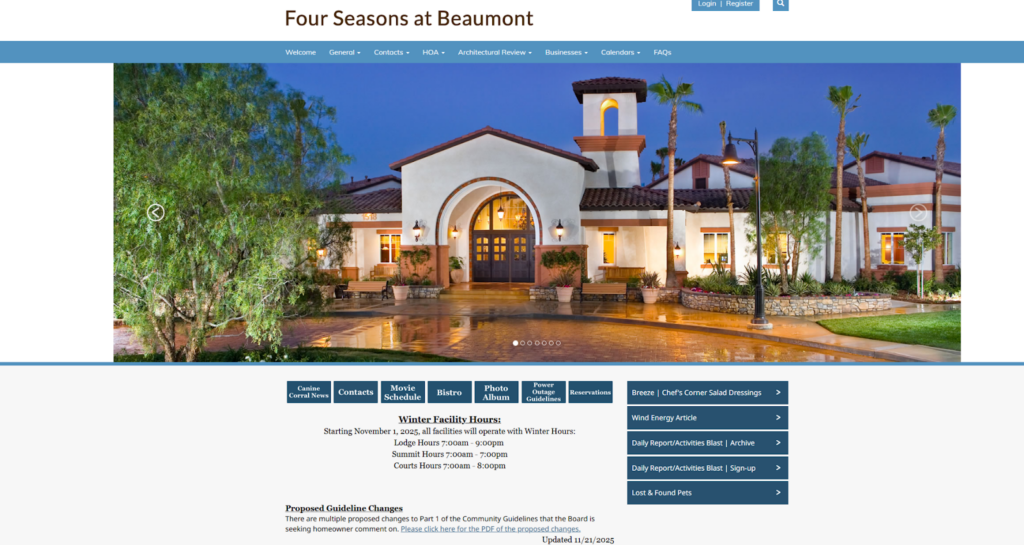
Now that you understand what transparency law requires, your HOA needs a method of providing residents with these documents. Even if your state hasn’t passed specific HOA website legislation, but does require transparency, establishing a website gives you an excellent way to share these materials and fulfill your legal obligations. Here is what I have learned works best:
Managing your documents
Your HOA website serves as an ideal repository for documents that residents have the legal right to review. I always recommend storing your CC&R rules, board meeting minutes, and financial statements where they are readily accessible.
However, not all documents should be public. Implement a login system for restricted materials. Here is something I have seen work particularly well: consider limiting access to certain or all documents to residents who are currently on their dues. This creates a practical incentive for payment while maintaining compliance with the transparency requirements.
Building a resident portal
The most effective HOA websites I have worked with serve dual purposes. They work for both current residents and prospective homeowners. Your current community members need efficient ways to handle HOA-related tasks, including checking account balances, submitting service requests, and retrieving important documents. An integrated online portal makes all these possible.
For example, the integrated portal allows members to gain immediate access to needed information and to complete necessary tasks through the integrated resident portal. This makes a huge difference when it comes to resident satisfaction. For security, each homeowner requires their own password-protected account, with board members maintaining the ability to manage these accounts. This is non-negotiable from both a legal and practical standpoint.
Creating a community calendar
If your HOA stays active, a website calendar becomes an invaluable tool. In my experience working with boards, modern families juggle increasingly busy schedules, so having a centralized reference point for upcoming events proves extremely helpful.
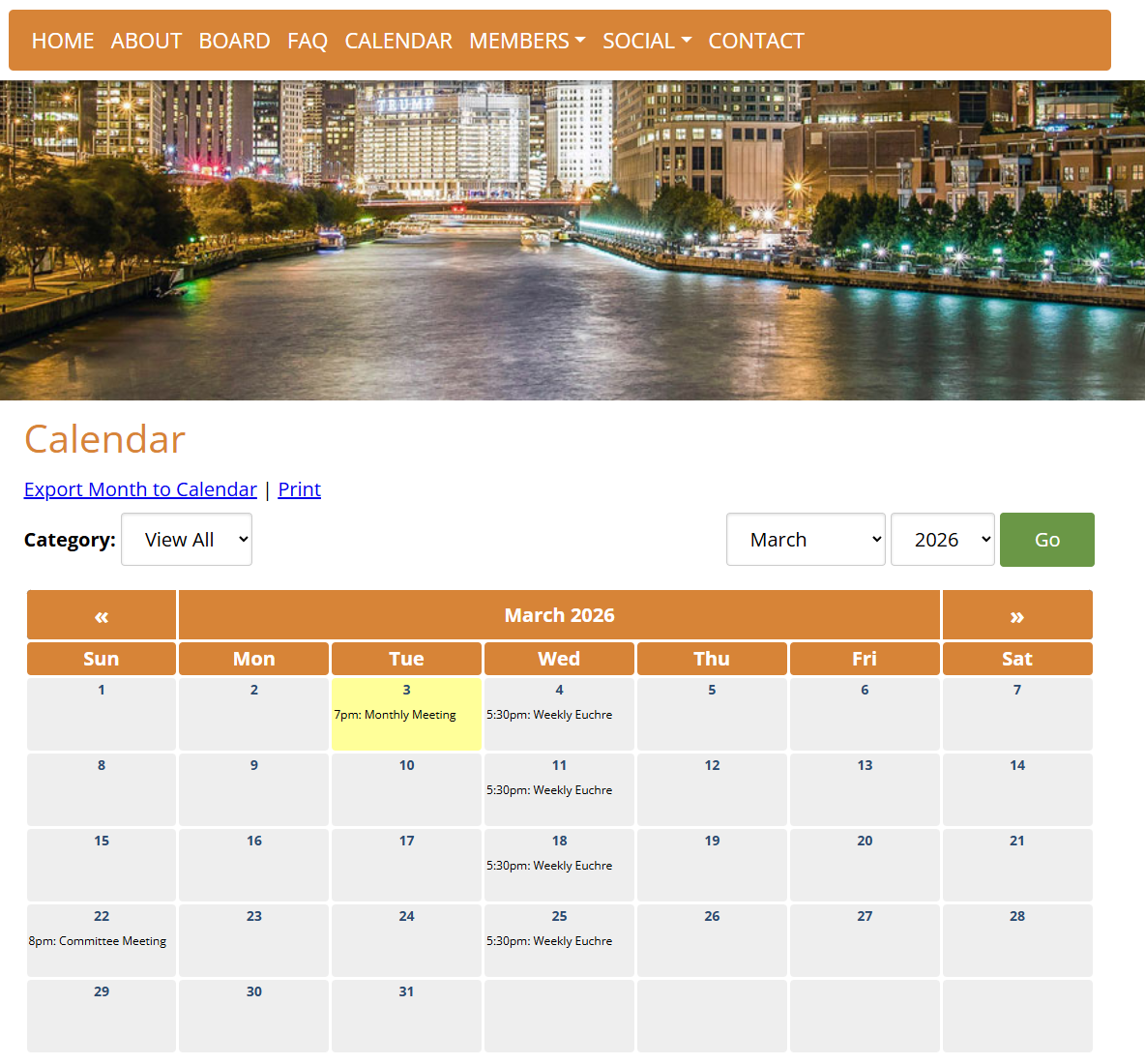
Include HOA meetings, community events, and project schedules with specific dates and times. Here is a feature I always recommend: when residents subscribe to this calendar, your association’s important dates automatically appear on their personal calendars, such as Google Calendar or Mac Calendar. This simple integration dramatically improves attendance at meetings and events.
Establishing communication channels
Since your HOA website functions as a central hub for all community-related matters, it should facilitate communication between members. Well-designed websites I have worked with include forums where members discuss topics ranging from gardening advice to questions about HOA rules.
Top-tier HOA websites also feature dedicated announcement sections. This approach saves both time and money for the association, while enabling immediate information sharing. I have seen associations cut their printing and mailing costs substantially by shifting to digital announcements.
Implementing polling features
While not mandatory, polling capability adds significant value to your HOA website. It streamlines voting procedures, removing the need for in-person voting. Naturally, your polling features should include safeguards, such as ensuring homeowners can vote only once. From my governance-minded perspective, this is where technology really shines in supporting proper HOA operations. You can conduct surveys, gauge interest in proposed changes, and even handle certain types of votes, all while maintaining a clear audit trail.
Setting up amenity reservations
Some homeowner’s associations, particularly those with thousands of members, limit the number of people who can use each community’s amenities simultaneously. Rather than managing this through phone calls, which I can tell you from experience is a nightmare, you can automate amenity reservations through your HOA website. This feature should include automatic wait list functionality and require residents to accept common area rules before finalizing each reservation.
Integrating online payment processing
Here is something I learned early in my career as a community manager: Collecting monthly dues ranks among the most demanding aspects of HOA management. Your association has probably relied on mailed checks, then tracked who paid and who didn’t, month after month after month. It is exhausting and error-prone.
Good HOA websites incorporate online payment portals where residents can pay dues and fees through their user accounts. This integration not only satisfies your residents but also significantly simplifies your treasurer’s responsibilities, making it easy to identify who has paid and who is late, send payment reminders, and generate reports quickly.
Final Thoughts
From a technical standpoint, a homeowners’ association website should prioritize information delivery above everything else. Why is this the case? In my years supporting self-managed HOAs, one of the most significant obstacles these associations encounter is distributing information efficiently. In some cases, associations hire property management companies specifically to improve information management and distribution processes. I have been on both sides of that equation, and I can tell you that a well-designed website can give self-managed communities many of the same advantages.
An HOA website makes it feasible to deliver essential information even in communities with hundreds of members, thereby satisfying the transparency requirements of the law. For instance, you can include a community calendar section that provides event details and helps owners track important dates. You can also create a secure online directory where homeowners access documents they are legally entitled to view.
When your directory automatically generates from information residents provide during sign-up, you can trust that your information remains accurate and that only association members gain access. This design ensures your website complies with the state-specific requirements, such as maintaining protected areas for sensitive information. Here is what I have learned: transparency isn’t just about following the state laws; it’s about building trust. When homeowners can easily access the information they need, when they can see how their money is being spent, and when they feel included in the process, your entire community benefits. That is the main benefit of getting your HOA website right.