
15 HOA website examples worth copying
Written by: Christine Ponce
Published on: September 10, 2026
Roughly 373,000 community associations operate in the U.S. today, housing about 78.1 million residents, more than a third of the country’s housing stock. And the number is projected to reach 377,000 associations and nearly 80 million residents by the end of 2026. Those residents already bank and shop online. In fact, the American Bankers Association’s 2025 survey found that 77% of people would rather manage money digitally than talk to a person, and 96% rated their digital banking experience positively.
These residents expect the same kind of digital experience when dealing with their HOAs. And state legislatures are also catching up, at least on disclosure. Florida has required HOAs with 100 or more parcels to maintain a website or app posting official records since January 1, 2025. And from January 1, 2026, that law extends to condo associations with 25 or more units. Texas sets its threshold at 60 lots. Nevada and Wisconsin have their own size-triggered versions. None of these laws care about layout or load speed, only whether a homeowner can find the budget, the bylaws, and meeting minutes on an HOA website.
On the management side, one legal review estimated that tracking down a single record, like meeting minutes or an insurance certificate, eats up roughly 18 minutes of staff time per request, multiplied across every owner asking that month. At the same time, 92% of owners want to solve problems themselves before calling. That means even if you manage to handle these requests manually, residents are never satisfied. A site that answers what owners ask most, like pool hours or a CC&Rs copy, means your board hears from owners only when something needs human judgment.
That said, not all HOA websites pay off, and let me show you why. 75% of people judge the credibility of an organization based on the design of their website, and that judgment happens in around 0.05 seconds of opening the site. So, as you move forward to get your HOA website and take advantage of the management, transparency, compliance, and resident satisfaction benefits I have talked about, you need to make sure you get a design that creates a positive image of your HOA. And for that, I have pulled for you 15 HOA website examples worth copying.
1. Village Green of Bradenton
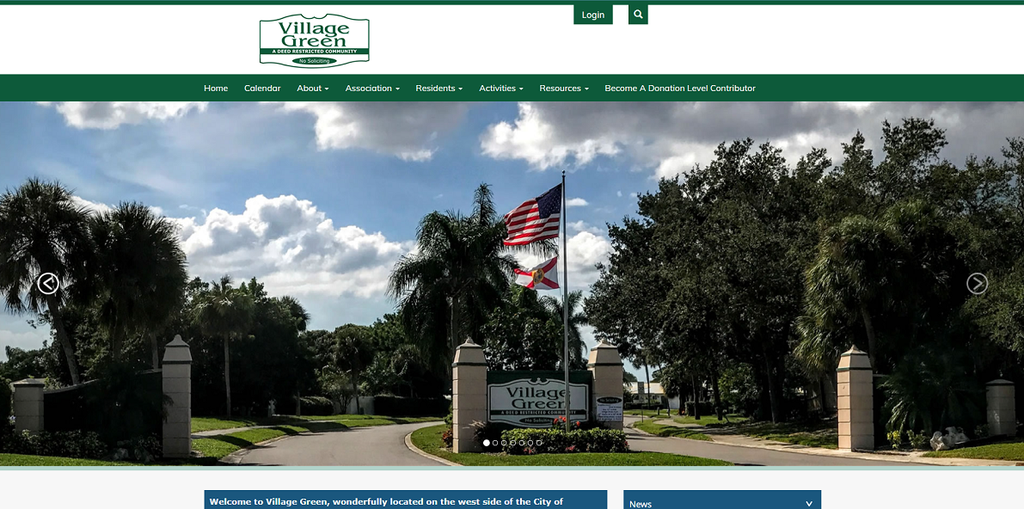
Village Green of Bradenton sits west of downtown Bradenton, Florida, toward the Anna Maria Island beaches, and its homepage is actually alive. Instead of a static landing page, visitors get a running, dated feed covering an annual meeting wrap-up, the pet-waste policy, dues instructions, and a request for flower-bed volunteers. VGHA also moved every event and activity off Nextdoor and onto its own site, purely to get real calendar and event-registration functionality a social feed doesn’t offer.
The financial pages go further than most sites here. If you pay dues online, the processing fee is waived. There’s also a dedicated estoppel contacts page, useful for real estate agents and title companies who need those documents fast.
2. One Water Place
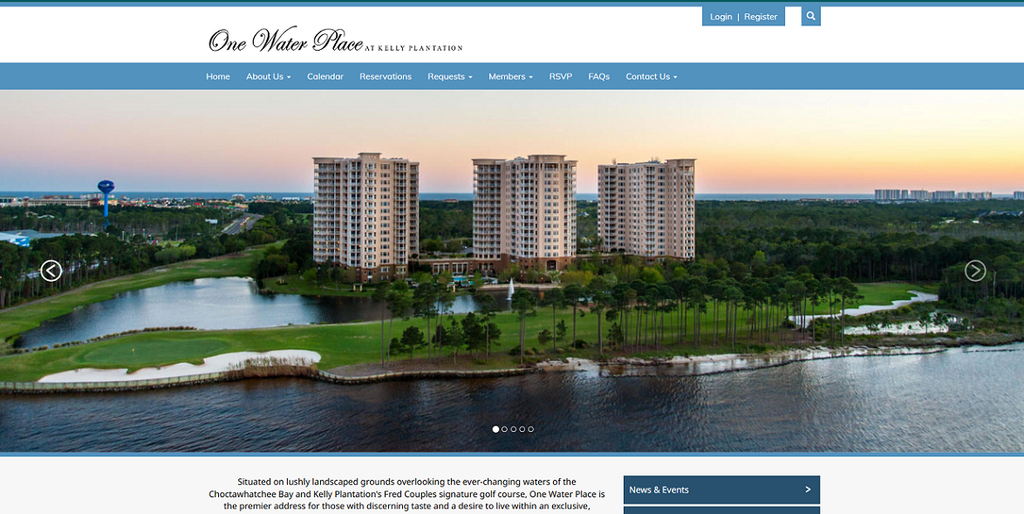
One Water Place is a gated bayfront condo community inside the Kelly Plantation development on Choctawhatchee Bay in Destin, Florida. This community’s website pushes self-service further than any other site on this list. Instead of one all-purpose contact box, it offers close to a dozen separate request forms, covering HVAC installs, maintenance, pet registration, delivery scheduling, unit modifications, move-in and move-out notices, and parking or storage transfers.
Two forms show the site was built around this specific property. Kayak and bike registration only makes sense when a board knows residents store watercraft on-site, and the Hurricane Help form lets a resident submit a real request during a storm rather than just read a static checklist. Ask whoever fields resident questions which requests come in on repeat, and turn each into its own form. It cuts back-and-forth and leaves a timestamped record of who asked for what. The homepage also names what’s waiting inside, like News & Events and the calendar, without displaying any of it to visitors who haven’t logged in.
3. Harmony
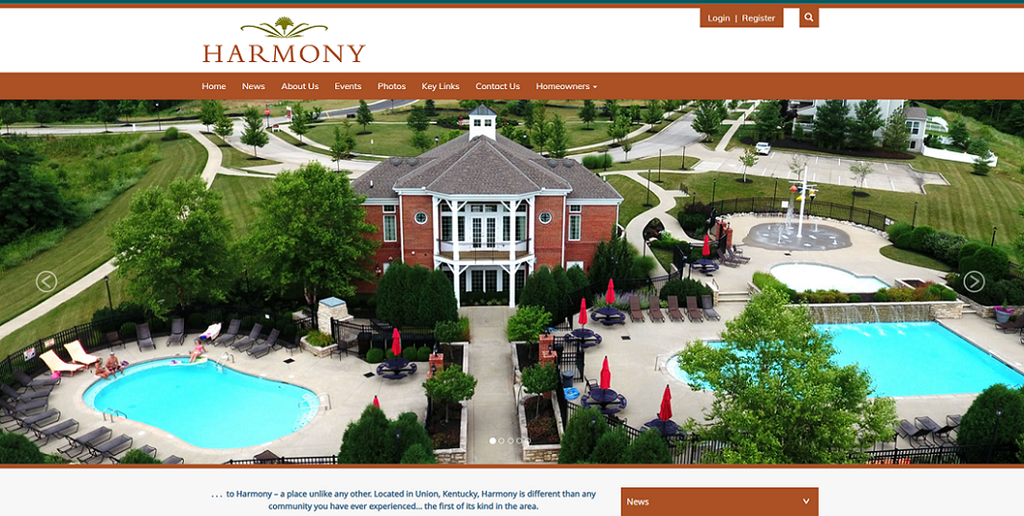
Harmony is a community in Union, Kentucky, split into four sections: Ascent, Patio, Master, and Condo, run by two different management companies: Towne Properties handles Ascent, Patio, and Master, while Vertex Professional Group runs Condo. Separate Master Board, Master Documents, and Condo Board pages keep them straight, so no one has to guess whose minutes they’re looking at.
You don’t need two management companies to land in this same spot. A master HOA with sub-associations, or a separate condo regime sharing the property, works the same way. But if you copy Harmony’s website and build your navigation to match your actual governance, residents won’t be digging through the wrong board’s files for their own documents.
Harmony also includes a dedicated Snow Policy page, useful in a Kentucky winter. Something I also like is the homepage. When you’re logged out, the welcome copy is generic enough to belong to any HOA in the country. But when you log in, you find real news and events.
4. Mill Pond at Stonehouse
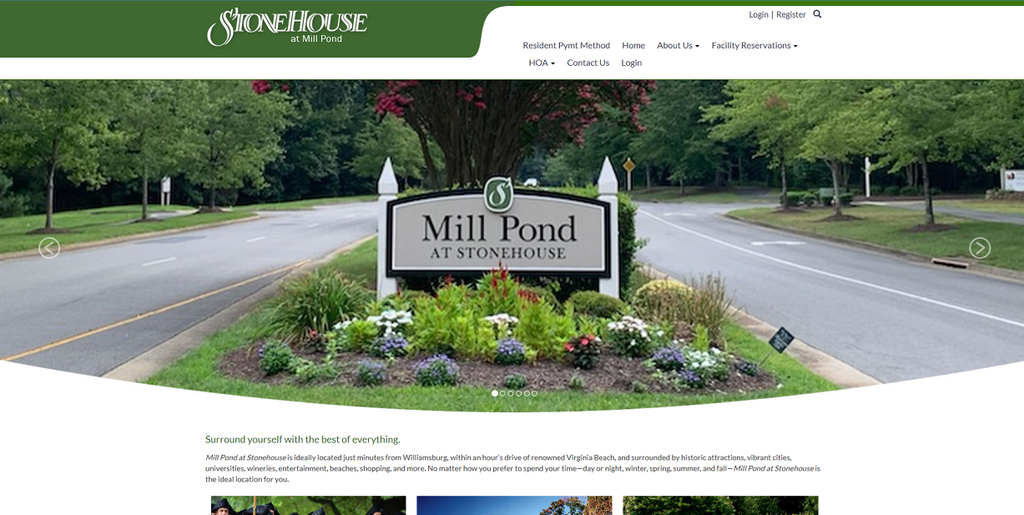
Mill Pond at Stonehouse is a golf-course community in Toano, Virginia, just outside Williamsburg. Their website skips the generic cul-de-sac photo most HOA homepages open with. Stonehouse Golf Club and the on-site Virginia Grill anchor the homepage instead, since that course is what most neighborhoods in the area are built around. If a golf course, marina, lake, or clubhouse genuinely sells your community, put it where a first-time visitor sees it first.
Other than that, the real strength is how much a resident can get done without calling. The Facility Reservations section lets residents submit real online requests for the clubhouse or for boat and RV storage, not something printed out and mailed in. A search bar in the header helps too, since the HOA menu alone carries eleven pages plus a dedicated FAQs & Tutorials page.
The footer adds one more good touch, stating plainly what the board is there to do: protect property values, maintain the community’s appearance, look out for owners’ interests, and run finances in the open.
5. Birnamwood Town Homes
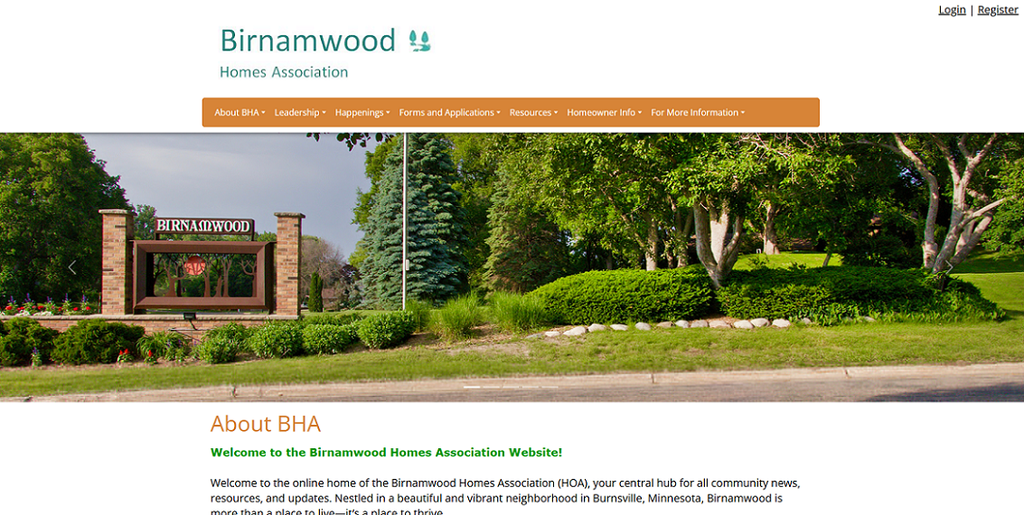
Birnamwood Town Homes sits across from a public nine-hole golf course in Burnsville, Minnesota, and its site is the most document-heavy here, fitting how the board works. The Birnamwood Homes Association runs on standing committees: Architectural Control, Facilities, Grounds, Homes Maintenance, and a Welcome Committee, and the site mirrors that with a dedicated page for each. If your association leans on committees, that structure is worth copying, since it tells every volunteer exactly who’s responsible for what.
The forms library covers parking permits, a landscaping modification request, an ACC repair request, a satellite dish agreement, and an ACH form for automatic payments. Every form carries a visible date, so a resident never fills out one quietly replaced eighteen months ago.
The standout is a plain-language memo on HO-6 condo insurance, covering what an owner’s own policy needs to cover once the master policy stops. Most associations only explain this after it’s caused a fight. Birnamwood puts it out in advance instead.
6. Summer Place
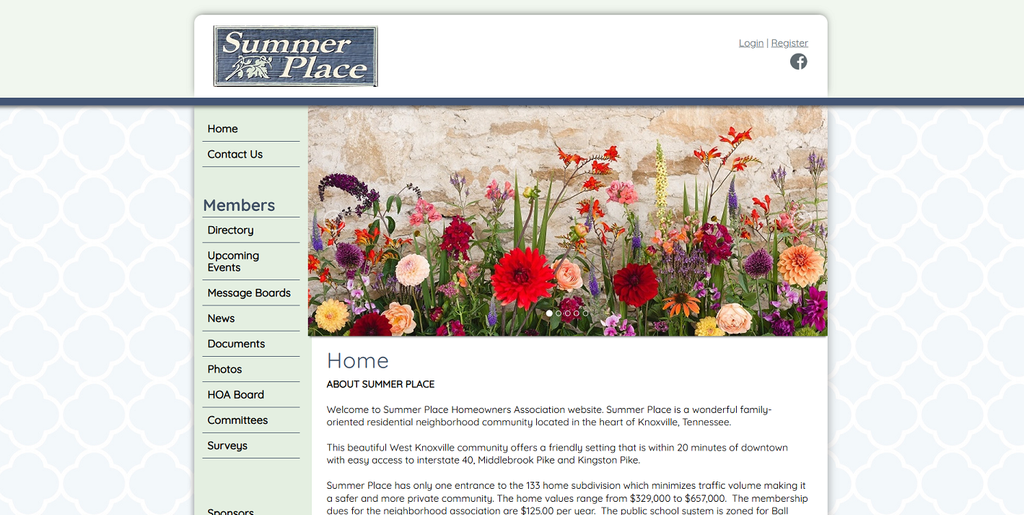
Summer Place is a 133-home neighborhood in West Knoxville, Tennessee. The community seems to miss a property management company. And considering that dues run $125 a year, remarkably low, it’s a signal towards a volunteer-run board with no management company or big management platform behind it. And that’s proof that budget isn’t a legitimate excuse for a site to look outdated.
The site is built for two-way conversation instead of one-way announcements, since there’s no office fielding day-to-day questions. Navigation leads with a resident directory, message boards, and a surveys section, plus a link to the neighborhood’s private Facebook group and an email sign-up for anyone who isn’t on it.
Most of the sensitive information is actually locked behind a login page, which is something I like. The homepage also doubles as a neighborhood fact sheet, with local home values right on the front page, plus the detail that the subdivision has one entrance and which schools it’s zoned into, information a buyer’s agent would otherwise track a board member down for.
7. Weatherstone Highlands Ranch HOA
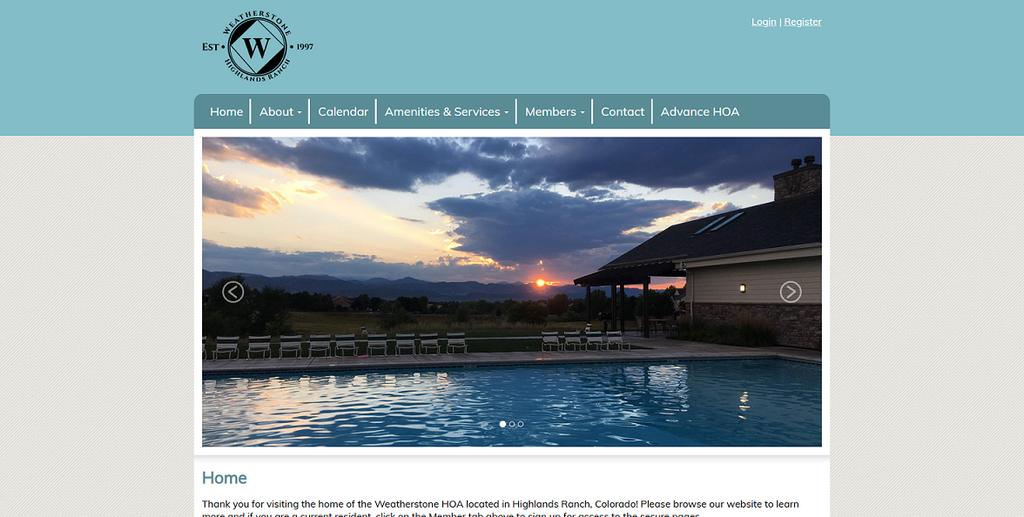
Weatherstone HOA in Highlands Ranch, Colorado, runs one of the more consistently active blogs on any community site. Nearly three years of posts cover Emerald Ash Borer warnings, pool opening dates, a garage sale, an Easter egg hunt, a Turkey Trot and hayride, holiday lights, and yard-waste pickup reminders, a running log of the year, not a News tab propped up with two stale posts.
The homepage also surfaces the next trash and recycling collection, exact date and time, instead of leaving residents to dig through a PDF. Landscaping and Snow Removal each get a dedicated page under Amenities & Services, reframing maintenance as a visible benefit of paying dues. There’s also a standing Block Captains program, volunteers assigned to specific streets who liaise between residents and the board.
8. Summerfield HOA
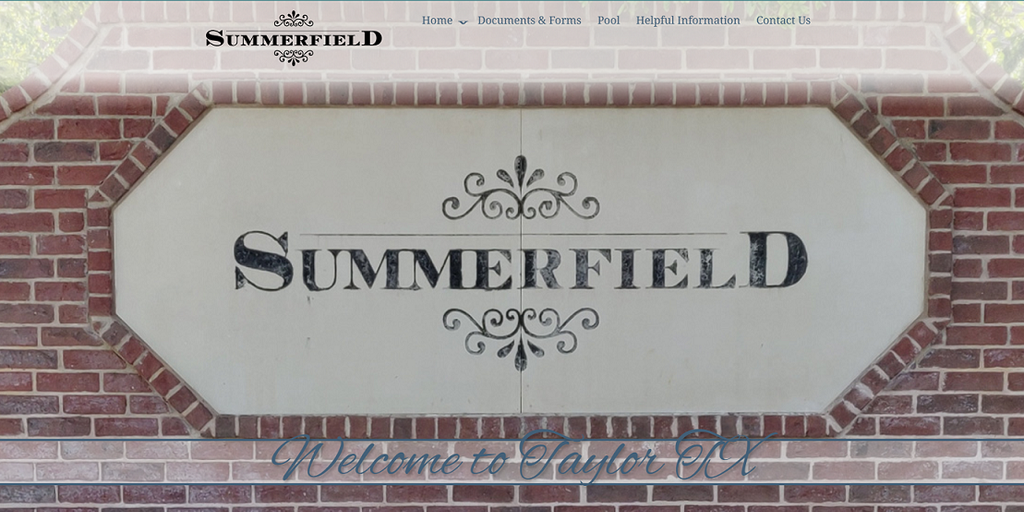
Summerfield HOA in Taylor, Texas, makes a point that trips up a lot of boards: your public website and the platform residents use to pay dues don’t have to be the same system. Summerfield’s site covers the information side (documents, meeting dates, and fee schedules). A separate platform, Smartwebs, handles payments and requests. Annual dues are $649, due every March, with a linked guide for paying online through the separate platform.
The resale certificate page spells out the transfer fee: 0.3% of the sale price split evenly between buyer and seller, plus a flat $375 certificate fee, useful when a title company needs the number fast. Architectural requests split into two paths, one for homeowners through the resident portal and one for contractors.
A few smaller details round it out: a pool access card program with its own waiver, an anonymous violation-reporting form, and meeting dates for the coming year posted well in advance, with public comment capped at three minutes per homeowner. The site also names every board member and flags open committee seats.
9. SunCrest Owners Association
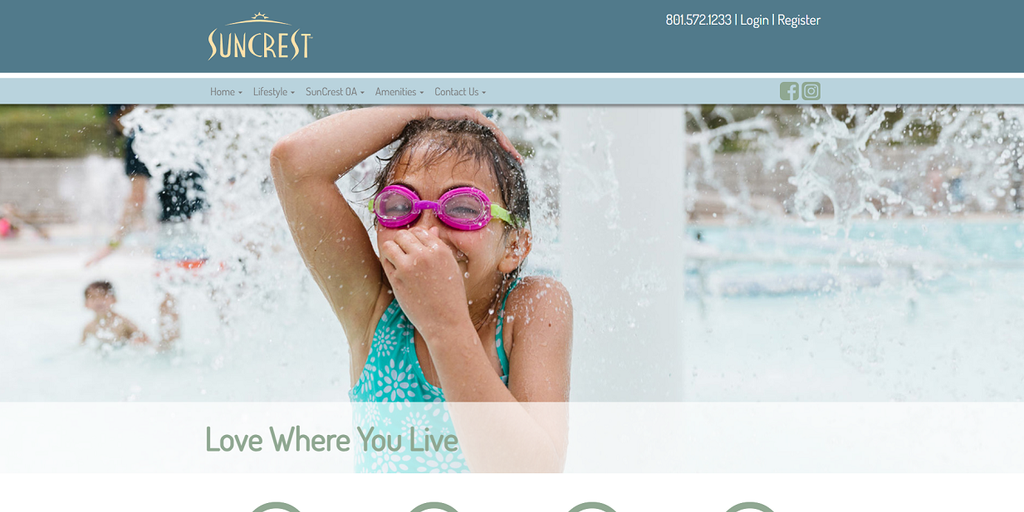
SunCrest Owners Association governs a 3,900-acre master-planned community on a mountain bench above Draper, Utah, making it one of the largest, most actively governed sites here. Like Summerfield, the public site sends residents elsewhere to log in to a platform called Buurt, run by CCMC.
What sets this homepage apart is how it updates current events. When I last checked it, it had three things running at once: a real board election with candidate profiles and a voting deadline, a proposal to lock in a trial RV-parking policy, and a seasonal update on pool hours. And that’s the difference between a site the board governs through and one that just looks presentable.
10. Little Whale Cove
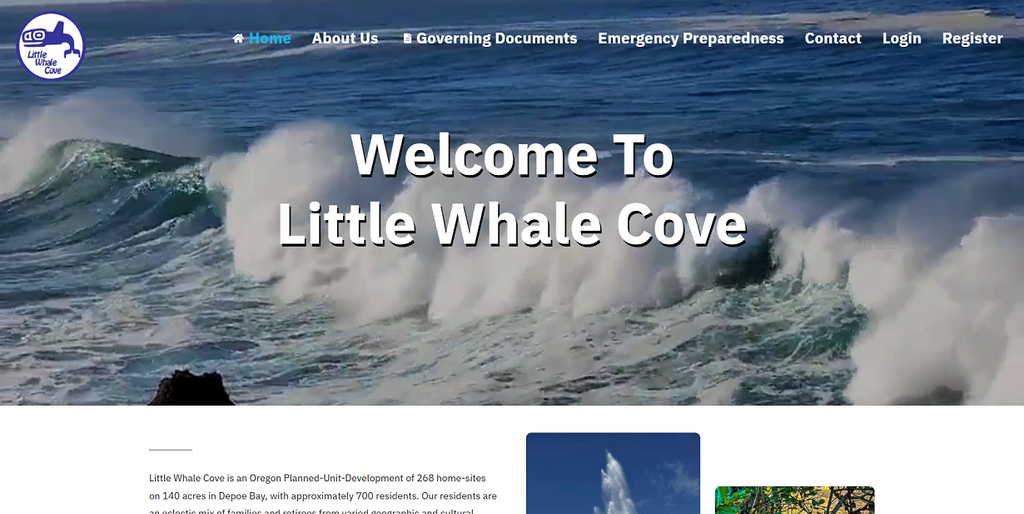
Little Whale Cove occupies 140 acres of volcanic cliffside in Depoe Bay, Oregon, a 268-home community of roughly 700 residents. The site is more about visual ambition. A video plays before a single word of text, followed by professional photography and lifestyle-magazine writing about the ocean and the cliffs.
The polish doesn’t distract from the fundamentals, though. It has a governing documents page that is easy to find, a standalone Emergency Preparedness section that’s backed by an active Safety Committee, and a news feed that looks current, with 2026 events like a summer happy hour. The site even splits its after-hours line, such as one number for anything that isn’t life-threatening, and 911 for anything that is.
11. Walden Lake Community Association
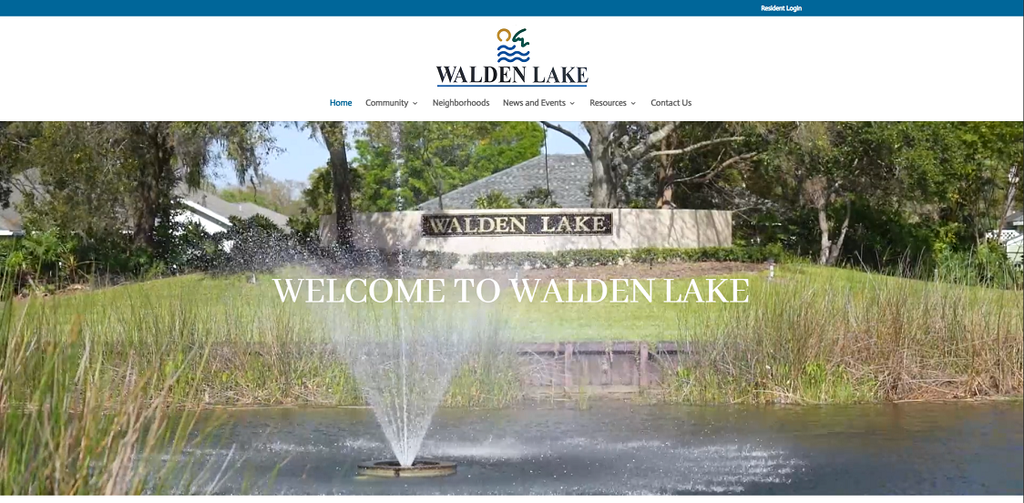
Walden Lake governs one of the largest, most segmented communities on this list: roughly 2,000 acres wrapped around a 62-acre lake, broken into more than thirty named sub-communities. Each gets its own standalone page instead of one shared feed, worth copying if your community has grown into distinct phases, so nobody on one street sifts through updates meant for a neighborhood forty times its size.
Few boards can replicate the governance here, but the idea holds. Under Florida’s Safe Neighborhood Improvement Plan, Walden Lake operates as an official Local Government Neighborhood Improvement District, with sitting City Commissioners on the board funding and managing its gates and guard staff.
The real standout is how the site handles bad news. Its Community News page posts direct updates, hearing dates and case numbers included, on litigation between the developer and the City of Plant City, and the Local Resources page links to police, fire and rescue, utilities, building permits, hurricane tracking, and the county sheriff.
12. Stonegate Country Club
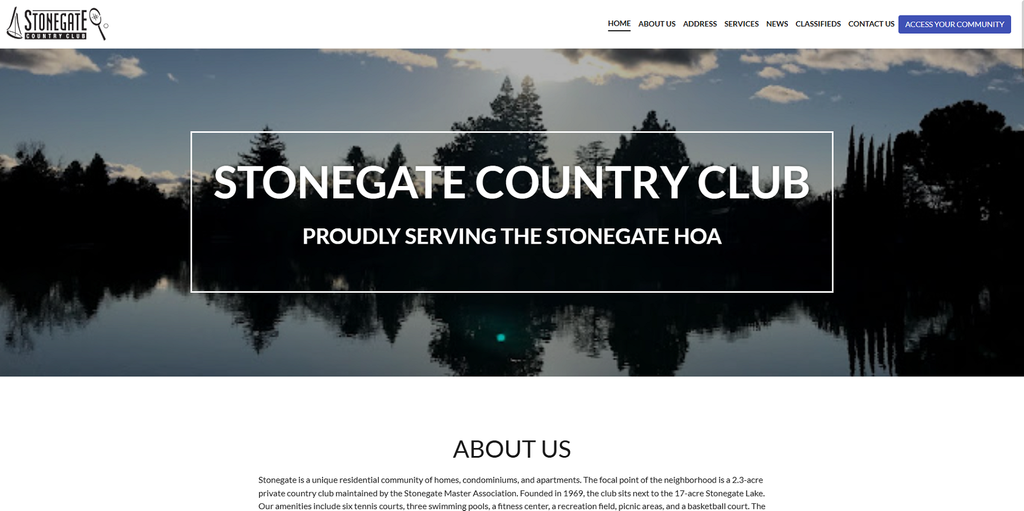
Stonegate Country Club is technically the amenity hub for the Stonegate HOA in Davis, California, and its membership page defines who actually belongs down to the address. Membership covers homeowners on or west of Lake Blvd, plus homes north of Tiber Avenue, specific enough to settle the question without a call to the board.
The site moves forward and lists the community amenities: six tennis courts, three pools, a fitness center, a recreation field, a basketball court, a dog park, and a 4,000-square-foot clubhouse rented out for weddings and events. The App Store and Google Play buttons sit on the homepage next to the web login, which means there are mobile versions of their digital presence. Their Services section is mid-update, walking members through proposed restated CC&Rs and bylaws.
Something I didn’t like about the site is the News section that has the newest posts dating back to 2024 and 2021. That’s too old, and even a well-built site runs cold without someone actually posting to it.
13. Aragon Neighborhood Association
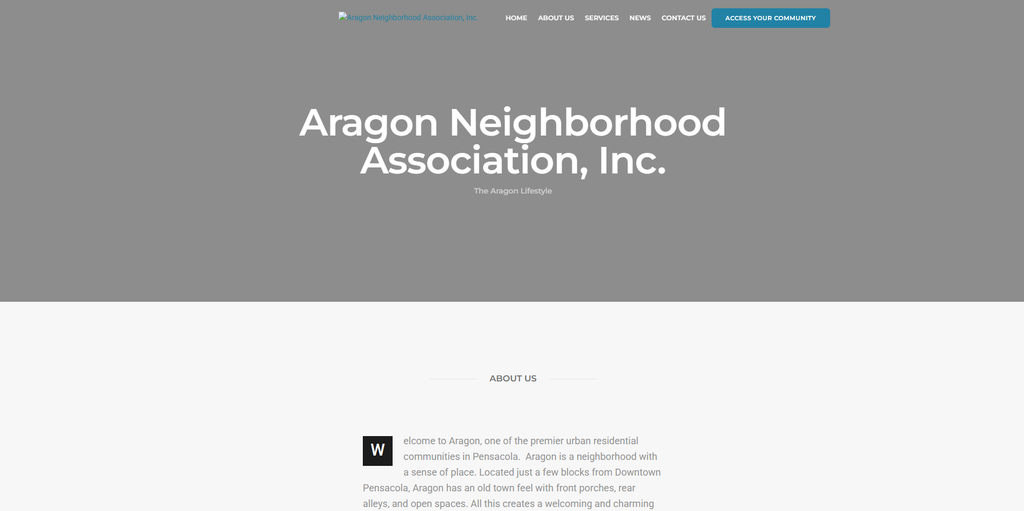
Aragon sits a few blocks from downtown Pensacola, Florida, a small, walkable, urban-infill neighborhood built on a former public housing site torn down in the 1990s and redeveloped in a New Urbanist, front-porch style. Its FAQ page tells that history, and its building guidelines catalog six distinct housing types: townhouses, cottages, park houses, sideyard houses, small cottages, and row houses. That means a resident knows exactly which category their house falls into, not vague language about neighborhood character.
The amenities are just as honest: a monthly book club, assigned plots in a shared community garden, and a linear park along Romana Street. No pool, no clubhouse, just an honest list of what the community actually has.
14. Canaan Woods
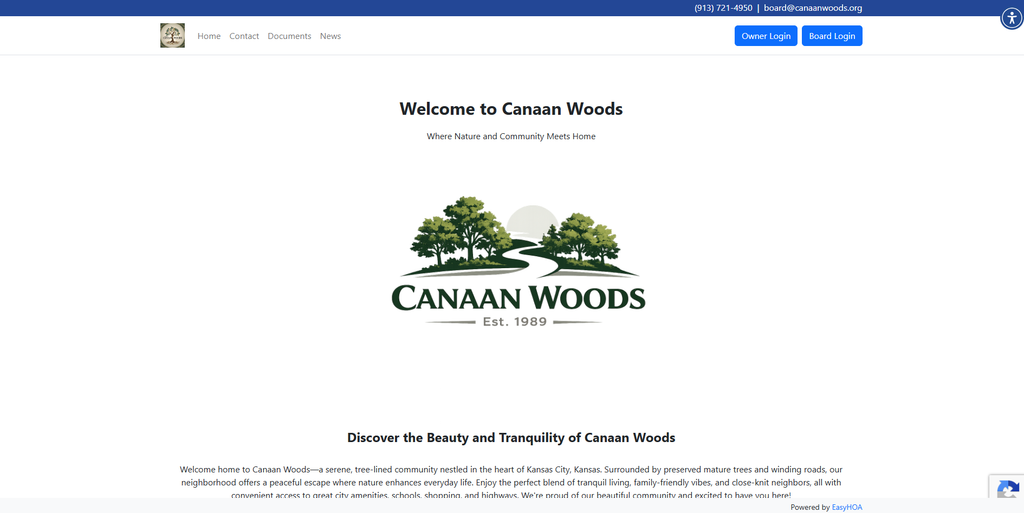
Canaan Woods in Kansas City is proof you don’t have to build a site that does everything. In fact, it’s possibly the leanest site here, with just four navigation items (Home, Contact, Documents, and News) and a homepage built around a short note about preserving the community’s mature trees and winding roads.
The one choice worth copying regardless of your size is how it handles login. Canaan Woods splits its login into two clearly labeled doors, Owner Login and Board Login, side by side, instead of the more common single sign-in box where board members only discover their extra permissions after logging in. That upfront signal matters for governance: owners know board-level material, like executive session notes and vendor contracts, lives somewhere separate.
Contact routes straight to a board email address rather than a management company, confirming this is self-managed.
15. Beau Chêne Homeowners Association
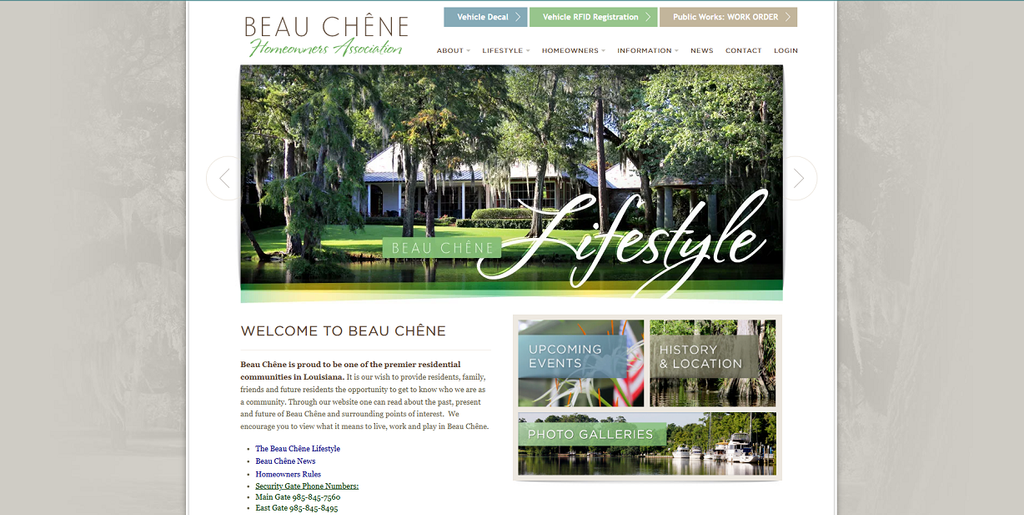
Beau Chêne, a large gated golf-and-marina community in Mandeville, Louisiana, follows a principle every gated or amenity-heavy community should copy: put what residents need constantly ahead of what just looks good. In this site, Vehicle Decal registration, Vehicle RFID Registration, and a Public Works work-order system all sit above the main navigation, well ahead of any tab covering the community’s history, since getting a car through the gate or reporting a broken sprinkler happens far more often than anyone clicks into About Us.
That same access-first thinking runs through the gate information. Instead of one switchboard number, each entry point (Main, East, and Marina) has its own direct line, since the community centers on both a country club and a marina, each with its own set of Lifestyle pages.
Final thoughts
When copying these website examples, figure out what your owners ask for on repeat, such as documents, online payment options, or ways to reach the board after hours, and build an HOA website that focuses on that. Also, remember that compliance laws in states like Florida and Texas set a floor, not a ceiling. Adding features that even estate laws don’t require, such as online payment portals and maintenance request forms, just makes your HOA management easier, organized, and more transparent. But that’s only achievable when you use a specialized HOA website builder, not just a generic builder.