
2026 HOA website compliance guide state-by-state
Written by: Stephen Smellie
Published on: January 23, 2026
In my years working with HOA boards across the country, I’ve watched the shift from paper notices pinned to physical bulletin boards to digital platforms happen almost overnight. And honestly, it has been a game-changer. Homeowners now have 24/7 access to governing documents; they can check event calendars, view meeting agendas, and find contact information whenever they need it. No more waiting for the monthly newsletter or hoping they caught that notice taped to the clubhouse door.
Most associations I work with structure their website with two levels of access: public-facing pages that display general community information, and a password-protected section for homeowners only. That protected section houses sensitive materials like CC&Rs, bylaws, rules and regulations, and internal records such as the Annual Policy Statement and Annual Budget Report. Some communities have even added interactive bulletin boards where residents post notices and discuss community matters.
But here is where it gets tricky: legal requirements vary dramatically by state. Some states mandate exactly what type of information can be posted on public pages versus what requires login credentials. Other states remain completely silent on the issue, with no direct laws addressing HOA websites at all.
When associations integrate bulletin boards into their website, many boards want to pre-approve notices or have the ability to edit or delete posts, especially to control situations where homeowners might post inappropriate content. I have had board members asking me about this more times than I can count. The problem is, the board doesn’t have that much freedom. There are illegal requirements around this as well that you need to understand.
In this guide, I will walk you through the 2026 HOA website compliance requirements state by state, so you know exactly what your association must do. I will also explain the legal requirements around bulletin boards and which content the board isn’t allowed to edit or delete.
States that mandate HOAs to have websites
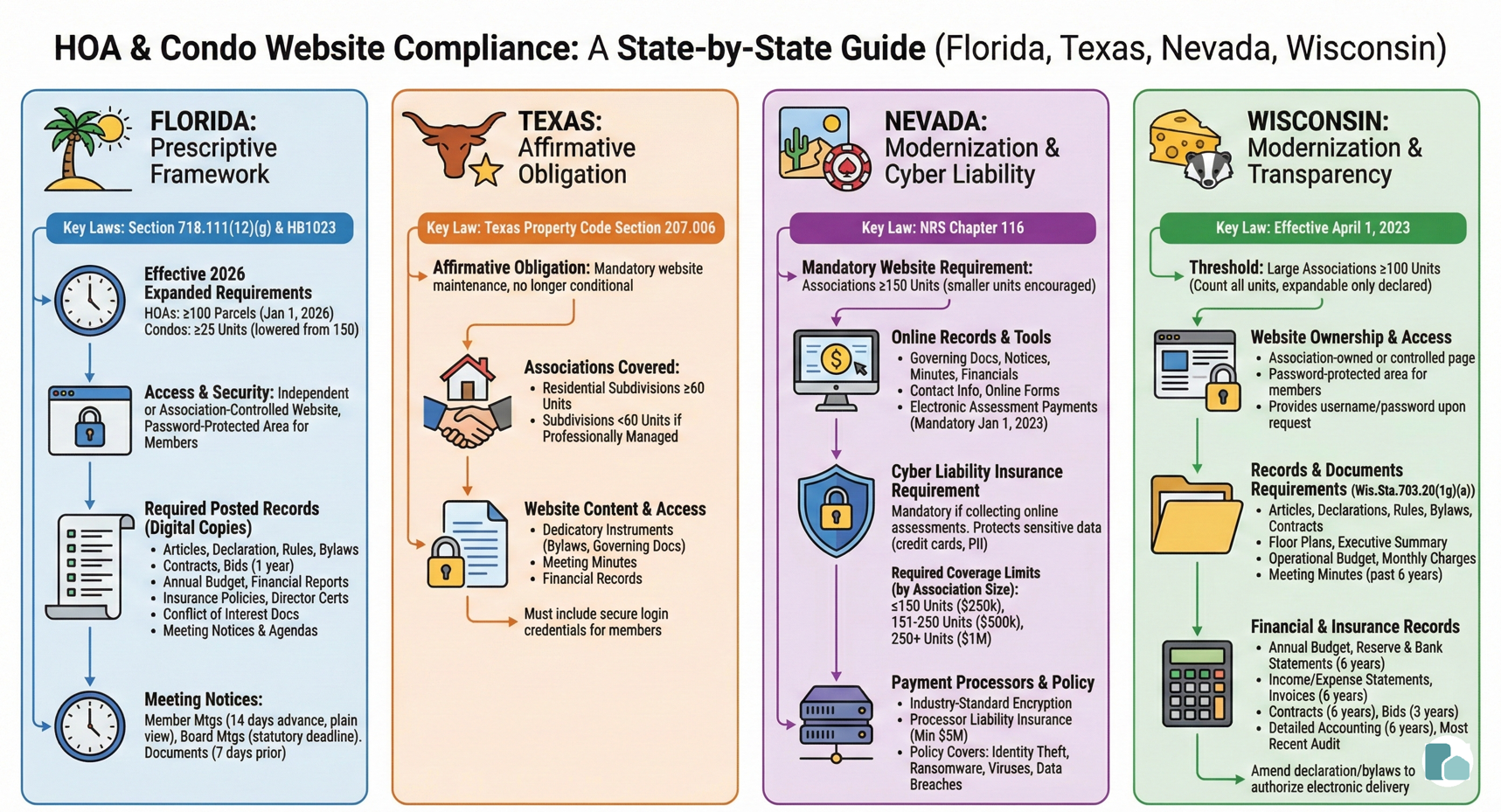
Over the years, several states have enacted laws that directly address HOA and condo association websites. California was one of the earliest states to formally tackle this issue. In 2011, the state passed Assembly Bill 548, which initially required HOAs with 50 or more units to have a website containing specified association information, unless two-thirds of the membership voted to opt out.
However, the mandate was later amended, and the blanket website requirement was ultimately removed. Even so, California laid the groundwork for the compliance-driven website requirements we see today. For the following states, having an association website is a must, although some have a conditional threshold based on association size before the website becomes a legal requirement.
Florida
Florida has one of the most prescriptive HOA and condo website compliance frameworks in the country. In 2017, the state passed Section 718.111(12)(g), requiring condominium associations with 150 or more units, excluding timeshare condominiums, to post specific association records online. The statute clearly detailed rules around the website where those records must be made available. For a website to be compliant in Florida, it must be:
- An independent website owned and operated by the association, or
- A website or a web portal operated by a third-party provider where the association owns, leases, rents, or retains the right to operate a dedicated page for association business.
The main reason behind this requirement makes perfect sense: if the association switches management companies, it keeps the website. That means there is never a time when the association loses its online presence and associated records simply because the previous manager owned the domain. Even without a legal requirement, I still strongly recommend doing this because I have previously seen boards scramble when they lost access to their entire digital history during a management transition, and it is never pretty.
Access and security requirements
The website must be accessible through the internet and include a portion that is not accessible to the general public. Compliance requires a password-protected area accessible only to homeowners, association board members, and employees. The protected area can be a subpage, portal, or any other electronic secure location.
Expanded requirements effective 2026
Florida has now broadened its digital access requirement for HOA websites with the passage of HB1023. Starting January 1, 2026, HOAs with 100 or more parcels must make specified official records available through an association website or mobile application. At the same time, Florida continues to lower the unit count threshold for condominium associations. Since 2019, condominium associations with more than 150 units have been required to maintain a compliant website. But beginning this new year, 2026, this requirement expands to cover associations with as few as 25 units. This dramatically increases the number of communities subject to website compliance laws.
Records that must be posted
To remain compliant, covered Florida condominium and homeowners associations must post digital copies of the following records on their association website or mobile application:
- The articles of incorporation and all amendments
- The declaration of covenants and all amendments
- The current rules of their association
- The recorded bylaws and all amendments
- A list of all current executory contracts and documents to which the association is a party, or under which the association or parcel owners have an obligation
- After bidding closes, a list of bids received within the past year for materials, equipment, and services will be provided.
- Annual budget or any other budget proposed to be considered at the annual meeting
- The association’s current insurance policies
- The financial report and any monthly income and expenses statements are to be considered at a meeting
- The certification of each director as required by section 720.3033(1)(a)
- All transactions and contracts between the association and any director, officer, corporation, firm, or entity in which a director has a financial interest, and that is not an affiliated homeowners association
- Any contract or document involving an actual or potential conflict of interest under Sections 468.436(2)(b) and 720.3033(2)
- Meeting notices and agendas
Florida also places strict timing and visibility requirements on meeting notices:
- Member meetings: Notices and agendas must be posted at least 14 days in advance. The notice must appear in plain view on the website homepage or on a clearly labeled “Notices” page linked from the homepage. Any document to be listed on the agenda or to voted on needs to be posted at least 7 days before the meeting.
- Board meetings: Notices, agendas, and required supporting documents must be posted no later than the statutory notice deadline under Section 720.303(3).
As with other required documents, these meeting-related materials must be accessible through a protected area of the website or mobile application.
Texas
In Texas, HOA and condo website requirements are governed primarily by the Texas Property Code. This code regulates how residential subdivisions and townhome associations are created, operated, and managed.
Historically,Section 207.006 of the Texas Property Code only required an association to post its dedicatory instruments online if the association or its management company already maintained a website. That meant many communities avoided website obligations entirely by simply not operating one. But that approach has now changed. The Texas legislature amended Section 207.006 to require most townhome communities and residential subdivisions to maintain a website accessible to their members. This change shifts the law from a conditional requirement to an affirmative obligation.
Associations covered
- Residential subdivisions with 60 or more units must maintain a website
- Subdivisions with fewer than 60 units are exempt unless the association is managed by a professional management company. That means if a management company is involved, the website requirement applies regardless of the association’s size.
Website content access
Texas law continues to require that all dedicatory instruments be made available on the association’s website. These include documents such as:
- Bylaws and governing documents
- Meeting minutes
- Financial records
The website must be accessible to members and include secure login credentials to protect sensitive association information.
Nevada
Nevada regulates condominiums and homeowner associations under the Common-Interest Ownership Act, codified in Chapter 116 of the NRS. This chapter has been updated to reflect modern expectations around digital access and transparency.
Mandatory website requirement
The amended Section NRS 116.31069 mandates that any association with 150 or more units must establish and maintain an electronic portal or secure internet website accessible to owners. Associations with 150 units or fewer are encouraged to maintain a portal or website, but are not legally required to do so.
Required online records
For associations that meet the threshold, the website or electronic portal must make available documents relating to the association, including:
- Governing documents: CC&Rs, bylaws, rules, and regulations
- Meeting notices: Timely posting of notices and agendas so homeowners are informed of upcoming meetings and decisions
- Meeting minutes: Published minutes allow owners to review board discussions and actions
- Financial records: Financial statements, budgets, and reports to promote financial transparency
Communication and administrative tools
Nevada law also recognizes the website as a functional administrative tool. Compliant association websites need to include:
- Contact information for board members, management, and committees
- Online forms allowing owners to submit requests and questions for better association communication
Electronic assessment payments
Modernization of NRS 116.31069 took effect on January 1, 2023. Associations subject to the website requirement must ensure their portal or website supports electronic payment for HOA assessments. The requirement seeks to improve association efficiency and resident convenience.
Cyber liability insurance requirement
Nevada has gone a step further than most states by tying HOA website use directly to insurance requirements. In 2023, the Nevada Legislature enacted a law requiring community associations to carry cyber liability insurance if they use an electronic portal or website to collect assessments online.
This requirement is directly tied to the online payment requirements and the risks involved. When you are collecting assessments online, the portal stores sensitive data like credit card information, bank account numbers, and other personally identifiable information, such as usernames, passwords, email addresses, names, and addresses. This data is highly attractive to cyber criminals.
Required coverage limits by association size
- 150 or fewer units: minimum coverage of $250,000
- 151 to 250 units: minimum coverage of $500,000
- 250+ units: minimum coverage of $1,000,000
Payment processors and data security
Nevada law also regulates third-party payment processes. If an association contracts with a processor to collect assessments, the processor must:
- Use industry-standard encryption and data protection measures
- Carry cyber liability insurance with a limit not less than $5 million
Policy coverage
The association’s cyber liability policy must cover losses arising from:
- Identity theft
- Ransomware
- Computer viruses
- Data breaches
- Unauthorized system access
- Other cyber-related exposures
Wisconsin
Wisconsin has joined states like Florida in modernizing association law to reflect current communication practices and transparency expectations. Effective April 1, 2023, Wisconsin law requires large associations to build and maintain a website. Generally, an association is considered large if it contains 100 or more units.
Website ownership and access requirements
Covered associations must maintain a website that meets the following criteria:
- The site must be accessible through the internet
- The site must have a password-protected area that all members of the association can access, but not the general public
- The association must own and operate the site. If a third-party provider operates the website under a contract, that contract must give the association control over a web page dedicated exclusively to association activities
- Upon written request from a homeowner, the association must provide a username and password
Records and documents requirements
The association must post current copies of documents, notices, and records that homeowners are entitled to inspect under Wis.Sta.703.20(1g)(a). Here are the records that the website must include:
- The articles of incorporation, declarations, rules and regulations, bylaws, employment, management, and other contracts affecting the access, use, and maintenance of the community
- Floor plans showing common elements and facilities available to homeowners, identifying which areas are parts of the association and which are owned by others
- The yearly operational budget and monthly charges for the lease, rental, or use of amenities that are not part of the association
- Meeting minutes and documentation of activities undertaken without a meeting in the past 6 years
- An executive summary meeting the formatting and content guidelines required by the statute
Financial and insurance records
- Annual budget, reserve account statements, bank statements, and financial statements from the past 6 years
- Income and expense statements from the past 6 years
- Invoices and expense records created within the past 6 years
- Contract entered within the past 6 years, including bids received within the past 3 years
- Detailed accounting documents showing expenditure receipts from the past 6 years
- The most recent financial audit, if any, regardless of when the audit was conducted
Unit count considerations and governing documents
The statute doesn’t differentiate between storage units, parking units, or residential units when determining whether the community meets the 100-unit threshold. To be on the safe side, I recommend counting all units. For expandable condominiums, only the units that are currently declared are included. Additionally, the association needs to amend the declaration and bylaws to formally authorize the delivery of official records and notices, such as payment reminders and bills, through the website and portals.
States with mixed-bag website provisions
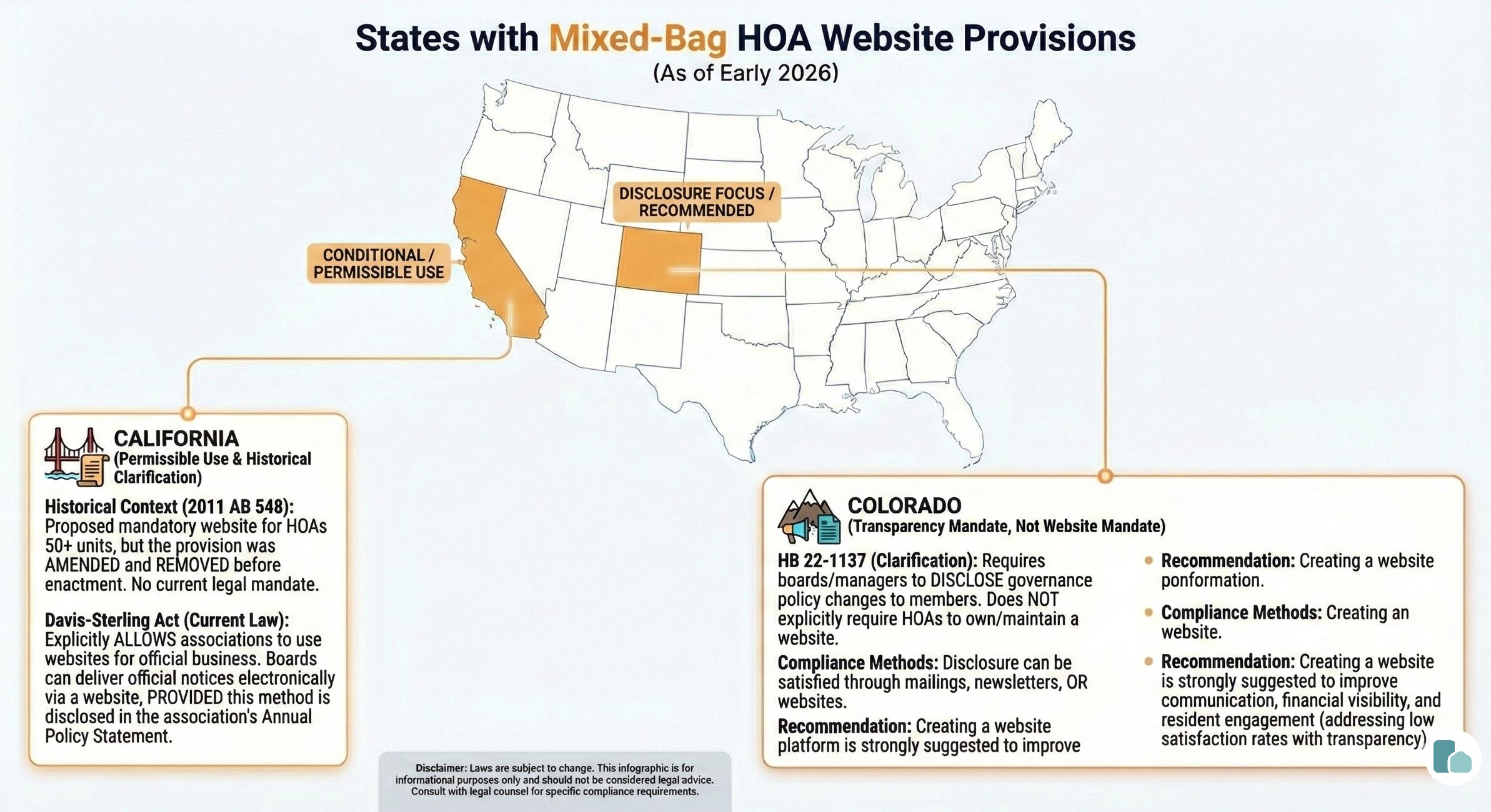
Not every state takes a hard-line approach to HOA website requirements. Some laws are frequently misinterpreted as website mandates when, in reality, they focus on disclosure methods, permissible usage of online tools, and transparency. California and Colorado are good examples.
California
California’s website requirements are a mixed bag. In 2011, California introduced Assembly Bill 548, which proposed a requirement for HOAs with more than 50 units to maintain a website. Some secondary sources still claim this bill became law. However, in my research, I found that the bill was amended before enactment, and the mandatory website provision was ultimately removed. As a result, California HOAs are not legally mandated to have a website.
That said, the Davis-Sterling Common Interest Development Act, which governs California HOAs and condominium associations, explicitly allows associations to use websites for official association business. It allows boards to deliver official notices electronically through a website, as long as this method of delivering information is already disclosed in the association’s Annual Policy Statement.
Colorado
Colorado presents a similar situation. Some sources claim that Colorado House Bill 22-1137 requires HOAs to create and maintain a website accessible to all owners. But that is not what the statute actually does. When I went through the statute once again, I found that the law focuses on governance transparency, not website ownership.
HB 22-1137 requires boards and community association managers to disclose changes in governance policy to community members through mailings, newsletters, and websites. In short, the law mandates transparency, but it doesn’t explicitly require HOAs to maintain websites. You can satisfy the disclosure requirement through printed mailings if you choose.
However, I recommend creating a website platform where members can view upcoming events and the association’s financial status. In a recent study I conducted across community associations, I found that only 38% of residents in condominium associations feel informed of board decisions. In HOAs, 32% of residents are not satisfied with the financial visibility the board provides. So, if you want to run an engaged community where nobody feels left out, I strongly suggest you invest in a website to improve communication and transparency.
ADA compliance
As with any public-facing service, places that HOAs use to host general public events must be ADA accessible. These include parking areas, meeting rooms, and clubhouses. Failure to address accessibility can expose an association to regulatory enforcement, fines, and lawsuits. Recent ADA updates have increased penalties and, in some cases, require medication and alternative dispute resolution before litigation.
As expectations around digital accessibility continue to rise, I recommend that HOAs evaluate their websites, mobile applications, and portals to ensure they are accessible to individuals with disabilities. Some best practices I recommend include:
- Screen reader compatibility
- Closed captioning for videos
- Keyboard navigation support
- Alternative text for images
- Sufficient color contrast for text
Electronic bulletin boards
If you’re considering integrating an electronic bulletin board into your website, I recommend understanding the liability landscape around it, especially when it comes to free speech. Courts don’t treat online bulletin boards the same way they treat traditional media like newspapers and radio stations. Entities that provide access to internet bulletin boards are granted broad immunity from liability for user-generated content, and online speech is protected under the First Amendment.
Here is what you need to understand: if the association allows candidates or members to use website bulletin boards during an election, equal access rules apply. If one candidate or group advocating a position is given access for election-related communications, the same opportunity must be extended to:
- All candidates
- Members advocating opposing viewpoints
- Individuals not endorsed by the board
The association is not allowed to edit, redact, or restrict these communications. However, the association can include a disclaimer stating that the candidate or member, not the association, is responsible for the content.
In short, you cannot restrict candidates’ statements on a bulletin board or edit a member’s election-related statement. The moment the association integrates the bulletin board into the website and opens the forum, you have created a public space with constitutional protections.
Moving forward
Beyond the state mandates, I have seen and experienced how association websites create stronger communities. Instead of printing meeting notices and hoping residents see them on traditional bulletin boards, post them on your website with a link to the agenda and an RSVP form. Track attendance, reduce paperwork, and improve engagement.
State legislatures continue adding website requirements, with some reducing the size of the threshold for website mandates. Moving forward, it seems that transparency through digital access is becoming the standard. My advice is this: instead of waiting for your state to mandate compliance, implement a website now. Build it with ADA accessibility from the start. You will avoid the scramble when legislation passes website mandates or ADA compliance laws, and you’ll serve your community better in the meantime.